On this page
- Same Watch, Two Very Different Faces
- Reverse Panda vs Classic at a Glance
- Classic Moonwatch (ref. 310.30.42.50.01.001)
- Moonwatch Reverse Panda (ref. 310.30.42.50.01.004)
- What They Share
- The Dial: Where the Real Difference Is
- The Classic Dial
- The Reverse Panda Dial
- Movement and Case: Identical Where It Counts
- Price: Is the Reverse Panda Worth the Extra?
- Resale Value: A Surprising Twist
- What About the Moonshine Gold Reverse Panda?
- Which Moonwatch Should You Buy?
- Buy the Classic Moonwatch If...
- Buy the Reverse Panda If...
- Buying Tips for Either Moonwatch
- Frequently Asked Questions
- What is the Omega Moonwatch Reverse Panda?
- How much is the Omega Moonwatch Reverse Panda?
- What's the difference between the Reverse Panda and the classic Moonwatch?
- Is the Reverse Panda worth the extra money?
- Does the Reverse Panda hold its value?
- Is the Reverse Panda a limited edition?
- The Bottom Line
Same Watch, Two Very Different Faces
For most of its life, the Speedmaster Moonwatch has had one face: black dial, black sub-dials, white hands. It's the look Buzz Aldrin wore on the Moon, and the reason a lot of people buy a Speedmaster in the first place.
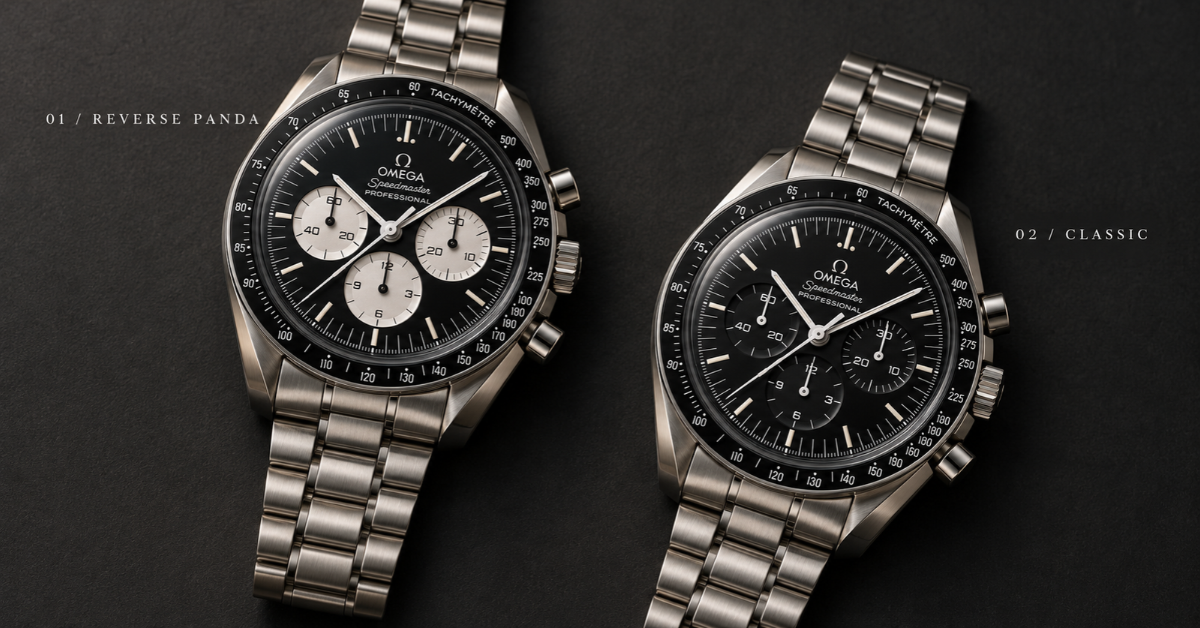
Then, in January 2026, Omega flipped the script. The new Moonwatch Reverse Panda keeps the black dial but turns the sub-dials white, in shiny lacquer. It's the first standard-production reverse panda in the modern Moonwatch Professional line, and it instantly became one of the most talked-about Speedmasters in years.
So now buyers face a real choice. Do you go for the icon, or the new twist? And is the Reverse Panda worth roughly $2,600 more for what is, mechanically, the same watch? Let's work through it.
Reverse Panda vs Classic at a Glance
Classic Moonwatch (ref. 310.30.42.50.01.001)
- Dial: matte black step dial with black sub-dials
- Look: the original Apollo-era design
- Price: around $7,800 retail in the US
- Pre-owned: often well below retail
Moonwatch Reverse Panda (ref. 310.30.42.50.01.004)
- Dial: polished black lacquer dial with white lacquer sub-dials
- Look: high contrast, more modern and dressier
- Price: $10,400 retail in the US (€10,200 in Europe)
- Pre-owned: so far trading close to retail
What They Share
- 42mm asymmetrical steel case, the modern version of the Apollo-era design
- Omega Co-Axial Master Chronometer calibre 3861, hand-wound
- About 50 hours of power reserve
- 50m water resistance
- Steel bracelet and the famous tachymeter bezel
The Dial: Where the Real Difference Is
Since the case and movement match, this choice really comes down to the dial.
The Classic Dial
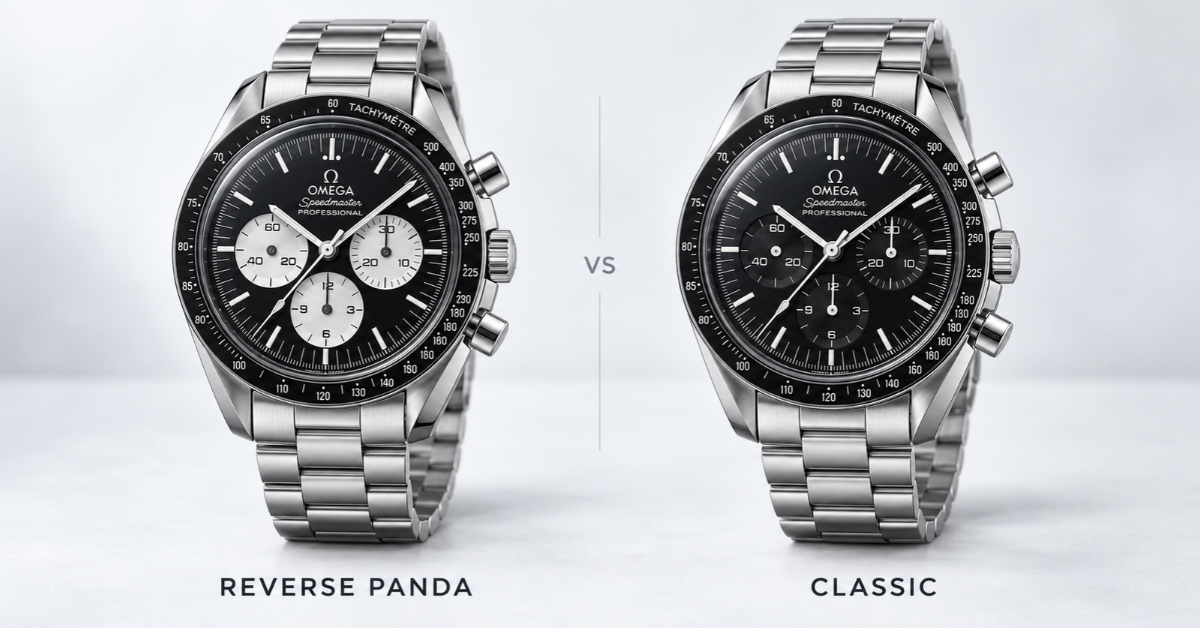
The classic Moonwatch dial is matte black, with a subtle step around the edge and black sub-dials. It's calm, tool-like and very legible. Nothing reflects, nothing distracts. It's a design built for a cockpit, and it still reads that way.
It's also the look with all the history attached. When people think "Moonwatch," this is the face they picture. If that story matters to you, our piece on the Speedmaster's Moon landing story shows why.
The Reverse Panda Dial
The Reverse Panda swaps matte for gloss. The main dial is polished black lacquer, and the three sub-dials (small seconds, 30-minute counter and 12-hour counter) are recessed and finished in white lacquer. The minute tracks are printed white on the black dial and black inside the white sub-dials.
The result is sharp contrast. The sub-dials jump out from across a room, and the lacquer gives the whole watch a deeper, richer look. It feels a touch dressier than the classic, which some owners love and some purists don't.
One practical note: glossy lacquer catches reflections more than a matte dial. In bright sunlight, the classic is a little easier to read at a glance. Indoors, most people won't notice.
Movement and Case: Identical Where It Counts
Both watches run the calibre 3861, the modern descendant of the calibre 321 that NASA astronauts relied on. It's hand-wound, so you give the crown a few turns every day or two. It's also a METAS Master Chronometer, tested for accuracy and resistance to magnetic fields up to 15,000 gauss.
Omega's Co-Axial escapement is a big part of why this movement is so robust. If you want the backstory, see how Omega's Co-Axial escapement changed watchmaking.
The cases are the same 42mm asymmetrical design, with the crown guards and the familiar tachymeter bezel. On the wrist, they feel identical. The only thing you'll notice is the dial.
Price: Is the Reverse Panda Worth the Extra?
This is the hardest part of the decision.
- Classic Moonwatch (hesalite): around $7,800 retail
- Reverse Panda (steel): $10,400 retail
- Reverse Panda (18k Moonshine Gold, ref. 310.60.42.50.01.002): $49,300 retail
That's roughly $2,600 more for the steel Reverse Panda. You're paying for the lacquered dial and, honestly, for newness. Mechanically, you get the same watch.
Retail prices vary a little between dealers and have moved with recent increases, so check our Speedmaster Moonwatch price guide for the latest numbers on every version, including the sapphire-crystal classic.
Resale Value: A Surprising Twist
Here's where the Reverse Panda earns some of its premium back.
The classic Moonwatch is made in large numbers, so pre-owned examples are easy to find, often thousands below retail. Recent data shows standard hesalite examples trading around $4,400 to $5,200 pre-owned.
The Reverse Panda, being new and in demand, has so far held its value much better. New and unworn examples have been listed by dealers at roughly $9,400 to $10,150, very close to retail.
Two caveats. First, that strength may fade as more Reverse Pandas reach the market. Second, a cheap pre-owned classic is still the best-value way into a Moonwatch by a wide margin. For a broader look at how Omegas hold value, see our Omega vs Rolex value comparison.
What About the Moonshine Gold Reverse Panda?
For those with a much bigger budget, Omega also makes the Reverse Panda in 18k Moonshine Gold (ref. 310.60.42.50.01.002). It adds solid gold hour markers and hands, with a Moonshine Gold PVD chronograph seconds hand.
At $49,300, it's a completely different purchase, more jewellery than tool watch. It looks stunning, but most buyers comparing the steel Reverse Panda with the classic won't have it on their list.
Which Moonwatch Should You Buy?
Buy the Classic Moonwatch If...
- This is your first Speedmaster
- You want the true NASA-era look and history
- Value matters, new or pre-owned
- You prefer a matte, purely functional tool watch
Buy the Reverse Panda If...
- You already own a classic Moonwatch and want something different
- You love high-contrast panda-style dials
- You want a Speedmaster that works a little better with smarter clothes
- You care about how close to retail your watch might hold its value early on
Our pick? For most people, especially first-time buyers, the classic Moonwatch is still the right answer. It's the original, it's cheaper, and it's the watch that made the Speedmaster famous. The Reverse Panda is a brilliant second Speedmaster, and a great first one only if the classic dial genuinely doesn't excite you.
Still weighing the wider range? Our guide to the best Omega Speedmaster models covers every option, and Speedmaster '57 vs Moonwatch helps if you're tempted by a more vintage look. And if you want the Moonwatch style on a tiny budget, here's our take on the MoonSwatch.
Buying Tips for Either Moonwatch
The Moonwatch is one of the most faked luxury watches in the world, and new releases like the Reverse Panda attract counterfeiters fast. Buy from an Omega boutique, an authorised dealer or a trusted pre-owned seller.
Buying used? Read 3 questions to ask before buying a used Omega Speedmaster first, then run through 9 checks to spot a fake Omega.
Frequently Asked Questions
What is the Omega Moonwatch Reverse Panda?
The Omega Moonwatch Reverse Panda (ref. 310.30.42.50.01.004) is a Speedmaster Moonwatch Professional with a polished black lacquer dial and white lacquer sub-dials. Released in January 2026, it's the first standard-production reverse panda in the modern Moonwatch Professional line.
How much is the Omega Moonwatch Reverse Panda?
The steel Omega Moonwatch Reverse Panda costs $10,400 in the US and €10,200 in Europe. The 18k Moonshine Gold version (ref. 310.60.42.50.01.002) costs $49,300.
What's the difference between the Reverse Panda and the classic Moonwatch?
The main difference is the dial. The classic has a matte black dial with black sub-dials, while the Reverse Panda has a glossy black lacquer dial with white sub-dials. Both use the same 42mm case and hand-wound calibre 3861 Master Chronometer movement.
Is the Reverse Panda worth the extra money?
It costs about $2,600 more than the classic for the same movement and case. It's worth it if you love the dial or already own a classic. For a first Speedmaster, the classic offers better value.
Does the Reverse Panda hold its value?
So far, yes. New Reverse Pandas have been listed by dealers at roughly $9,400 to $10,150, close to the $10,400 retail price. Classic Moonwatches typically sell for well below retail pre-owned.
Is the Reverse Panda a limited edition?
No. The Omega Moonwatch Reverse Panda is part of the regular Speedmaster Moonwatch Professional collection and is available from Omega boutiques and authorised dealers.
The Bottom Line
The classic Moonwatch is the legend. The Reverse Panda is the legend in a sharper suit. Underneath, they're the same brilliant watch, so the right choice is simply the face you'll be happiest looking at every day.
If you're buying your first Speedmaster, start with the classic. If you already have one, the Reverse Panda might be the most fun way to buy the same watch twice.
Editor-in-Chief
Editorial Team