On this page
The part of a mechanical watch that makes it tick had barely changed since the mid-1700s. Then, in 1999, a Swiss brand started selling a watch with a different one. What happened between those two dates is a better story than the marketing version, and it explains why Omega talks about this component more than any other.
The Problem Nobody Had Fixed
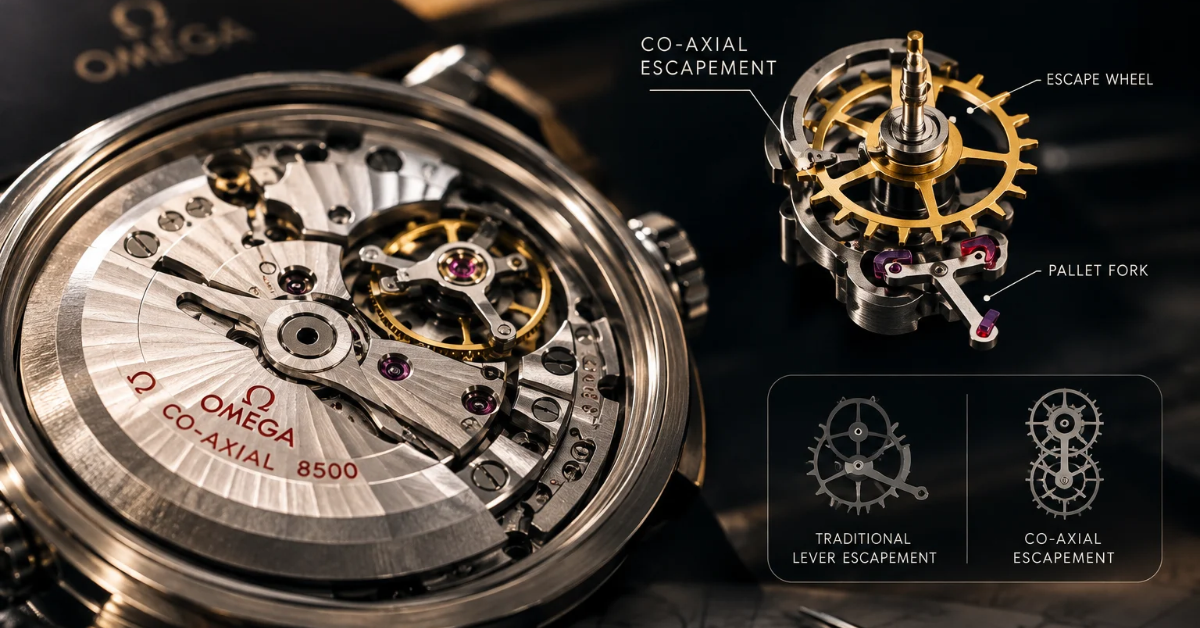
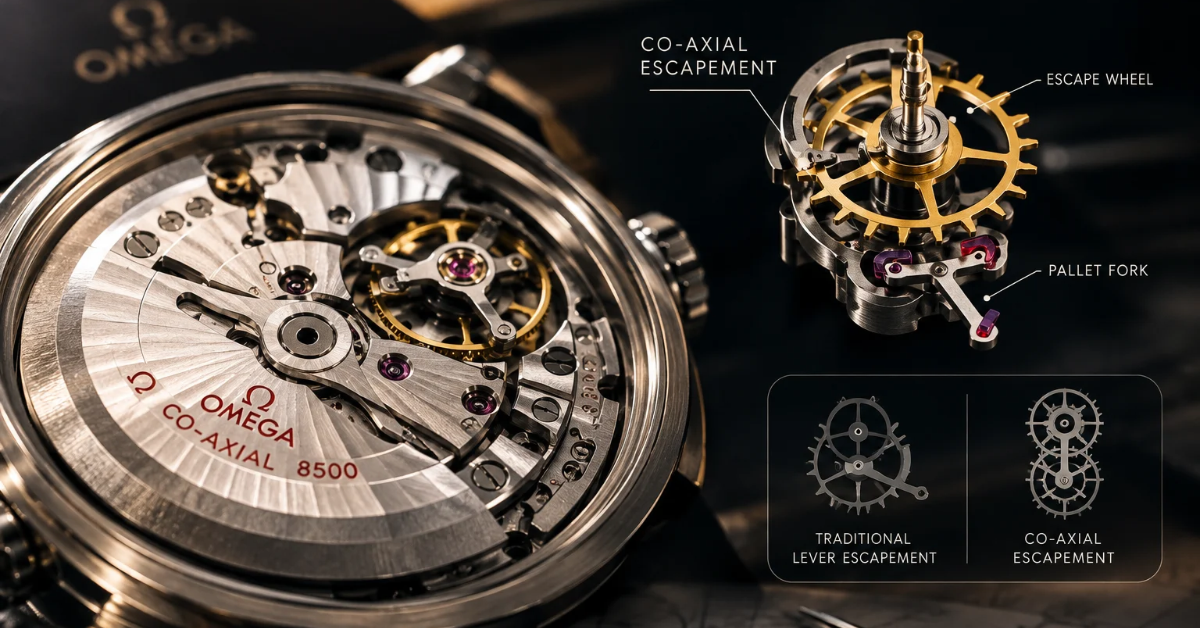
Every mechanical watch needs an escapement, the part that releases the mainspring's energy in small, regular bursts. For about two and a half centuries, almost every watch used a version of the Swiss lever escapement, which Thomas Mudge devised in 1754. It works, but its parts slide against each other, and sliding friction needs oil. As the oil degrades, accuracy suffers and wear increases. That's why mechanical watches need servicing. Our simple explainer on the Co-Axial escapement covers the mechanics in plain language. This piece is about how it got to your wrist.
An Invention Nobody Wanted
George Daniels, the English watchmaker widely ranked among the greatest of the 20th century, finished his design in 1974 and patented it in 1980. The timing could hardly have been worse. The quartz crisis was crushing the Swiss industry, and brands weren't in the mood for a radical rethink of a mechanical component. Daniels took his drawings around and, by most accounts, found no takers.
So he built it himself. Around 1975, he fitted a hand-made Co-Axial escapement into his own Omega Speedmaster, which became the first working prototype. The Speedmaster connection is a nice irony. The watch that went to the Moon, which we cover in our piece on why the Moonwatch actually went to the Moon, was also the first to carry this escapement.
How Omega Got It
By the 1990s, the mechanical watch was fashionable again, and Swatch Group's then chief, Nicolas Hayek, saw what Daniels had. Omega acquired the rights and began the long work of turning a handmade design into something a factory could build in volume. Exact dates for the deal vary between accounts, so the safe version is simply that it happened in the 1990s.
In 1999, Omega launched the first series-produced watch with the Co-Axial escapement, a De Ville limited edition reportedly capped at 999 pieces. Its Caliber 2500 started life as the ETA 2892 and was modified to take the new escapement. Swatch Group later described it as the first practical new mechanical escapement in 250 years. The word that matters there is "practical". Prototypes can be brilliant. Production watches have to survive thousands of owners.
From One Watch to the Whole Catalog
Omega moved quickly once the 2500 proved itself. According to Swatch Group's own history, within a decade the Co-Axial escapement was in every Omega watch line. The next big step came in 2007 with Caliber 8500, the first movement Omega built entirely around the Co-Axial escapement, with every one of its 202 parts developed in-house for it.
From there, the escapement became the foundation for other advances:
- Magnetic resistance. The 2014 Aqua Terra rated to 15,000 gauss used a Co-Axial movement built from non-ferrous materials. Our complete Seamaster history covers that milestone.
- Master Chronometer certification. Introduced in 2015, it tests whole watches for accuracy and magnetism through Switzerland's federal metrology institute. One watch writer argues Omega might never have launched such an ambitious program without a movement already built around the Co-Axial. That's an opinion, but a reasonable one. See our guide to verifying Master Chronometer certification.
- New testing methods. Omega's more recent work, including the acoustic testing behind the Constellation Observatory, builds on the same engineering identity. We cover it in what actually changed with the Observatory.
- Materials. Omega's willingness to experiment, from silicon to Liquidmetal, fits the same pattern. Our explainer on the Liquidmetal bezel is one example.
What It Actually Changed
It broke a 250-year spell. Before 1999, the working assumption was that the escapement was a solved problem. Showing that a new one could be built at scale changed what the industry thought was possible, even for brands that never used it.
It gave Omega an engineering identity. For many buyers, Omega became the brand that did technical things, not only the brand that had gone to the Moon. That identity shapes its marketing, its testing standards and, to a degree, its pricing.
It changed what owners can expect. Reduced friction means the oil lasts longer, which is the mechanical reason Omega recommends servicing every 5 to 8 years rather than the 3 to 5 typical elsewhere. Our guide to how long an Omega lasts covers the real-world implications.
What It Didn't Change
An honest account has to include the limits. The Co-Axial escapement never became an industry standard. Omega was the first user and remains the main one. Other brands pursued their own escapement improvements instead, and the lever escapement is still what most mechanical watches use. Daniels himself said he designed it to keep the public's affection for the mechanical watch alive through the 21st century, and by that measure it has done its job.
It also took a very long time. Roughly 25 years passed between Daniels' invention and the first production watch. Good ideas in watchmaking move slowly, and this one needed a corporate patron with the patience and the factories.
Why a Buyer Should Care
If you're shopping for an Omega today, the Co-Axial escapement is the common thread through the whole catalog. It's the reason servicing intervals are longer, the foundation under the certification, and the technical story behind the price. Our Omega Watches Buying Guide helps you decide which collection fits you.
FAQ
Who invented the Co-Axial escapement? English watchmaker George Daniels, who finished the design in 1974 and patented it in 1980.
When did Omega start using it? In 1999, with the Caliber 2500, a modified ETA 2892, in a De Ville limited edition.
Was it really the first new escapement in 250 years? Swatch Group describes it as the first practical new mechanical watch escapement in 250 years, since Thomas Mudge's lever escapement of 1754.
Do other brands use the Co-Axial escapement? Omega is the first user and remains the primary one. It never became an industry standard.
Why does the Co-Axial escapement reduce servicing? It cuts sliding friction, so the oil lasts longer, which supports Omega's recommended 5-to-8-year service interval.
Is the Co-Axial escapement the same as Master Chronometer certification? No. The escapement is a mechanical design inside the movement. Master Chronometer is a separate testing standard applied to the finished watch.
Conclusion
The Co-Axial escapement didn't revolutionize every watch. It changed something narrower and more interesting: it showed that the oldest unfinished business in mechanical watchmaking could still be finished. Daniels drew it, a corporation industrialized it, and an entire brand rebuilt its identity around it. That's change enough.
Editor-in-Chief
Editorial Team