On this page
- Two Different Years, Two Different Stories
- Design: Vintage Motorsport vs. Space-Tested Asymmetry
- The Real Functional Difference: Automatic vs. Manual-Wind
- Movement and Certification
- Case Size and Fit
- Pricing
- Both Are Genuinely Strong Value Performers
- So, Which One Fits You?
- Buying With Confidence
- FAQ
- Conclusion
The Speedmaster '57 and the Moonwatch Professional are both genuine vintage reissues, but they honor different moments in the Speedmaster's history. The '57 revives the original 1957 Speedmaster CK2915 — the very first Speedmaster ever made, built for motorsport, years before NASA existed as a customer. The Moonwatch Professional continues the direct lineage of the watch NASA actually flight-qualified and flew to the Moon. The '57 runs a slimmer automatic movement at 40.5mm; the Moonwatch runs a hand-wound movement at 42mm. Current Moonwatch hesalite pricing sits around $9,600, with the '57 generally positioned below that.
Both of these watches get called "vintage reissues," and both descriptions are genuinely accurate — they're just accurate about two different watches from two different years. Understanding which specific history each one revives is the fastest way to figure out which actually fits what you want from a Speedmaster.
Two Different Years, Two Different Stories
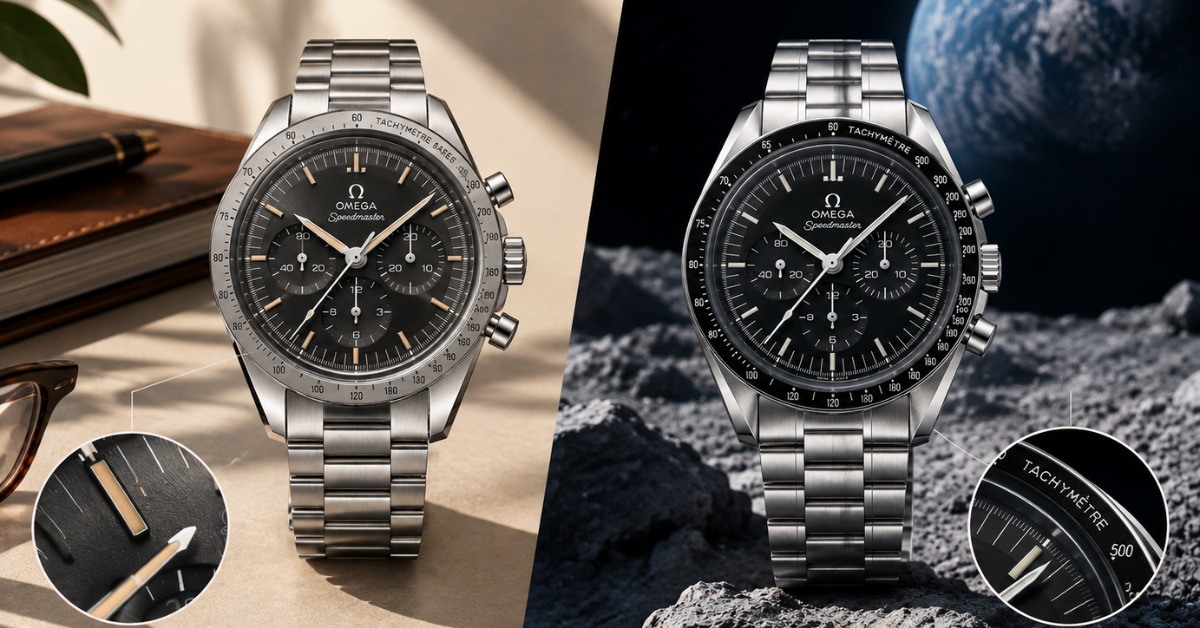
The Speedmaster '57 does exactly what its name says: it revives the original 1957 Speedmaster, reference CK2915 — the watch that started the entire Speedmaster line, three years before Omega had any connection to NASA at all. It was built as a motorsport chronograph first, full stop, and the '57's broad arrow hands and symmetrical case design trace directly back to that original, purely automotive-focused watch.
The Moonwatch Professional tells a different, later chapter — the direct descendant of the reference NASA tested and flight-qualified in 1965, the watch that flew on Gemini and Apollo missions and was worn on the lunar surface in 1969. Our piece on why the Moonwatch actually went to the Moon covers that specific NASA testing history in full — a story that belongs to the Moonwatch lineage specifically, not the '57.
Design: Vintage Motorsport vs. Space-Tested Asymmetry
The current Speedmaster '57 runs a symmetrical stainless steel case, brushed and polished, at 40.5mm and just 12.99mm thick — genuinely slim for a chronograph. It carries broad arrow hands, a laser-engraved tachymeter bezel, and a case shape that reads as cleaner and more classically proportioned than the Moonwatch, a direct reflection of its 1957 motorsport origins rather than any space-flight testing requirements.
The Moonwatch Professional keeps the case architecture NASA's testing actually shaped — twisted, asymmetric lugs, crown guards, and the "dot over ninety" bezel detail that's become one of its signature identifying features. Our Speedmaster fake-spotting guide covers several of these exact design details in more depth, useful for understanding just how specific and considered the Moonwatch's proportions actually are.
The Real Functional Difference: Automatic vs. Manual-Wind
This is the distinction that should actually drive your decision more than anything cosmetic. The current Speedmaster '57 runs a Co-Axial Master Chronometer movement that's automatic — self-winding through normal wrist motion, no daily ritual required. The Moonwatch Professional's Caliber 3861 is hand-wound, meaning it needs manual winding via the crown, typically once a day, to stay running.
That's a genuinely different ownership experience, not a minor technical footnote. Some owners find the Moonwatch's manual winding a satisfying, deliberate daily habit; others find it one more thing to remember, particularly if the watch sits unworn for a few days. Our Speedmaster vs Seamaster comparison covers this exact manual-wind trade-off in more detail, since it's the same consideration that applies when weighing any hand-wound Speedmaster against an automatic alternative.
Movement and Certification
Both watches currently carry Co-Axial Master Chronometer certification, independently verified by METAS to resist magnetic fields up to 15,000 gauss — genuinely equivalent engineering credentials despite the very different winding mechanisms underneath. Neither watch is the "more advanced" one on paper; they're simply built around different priorities.
Case Size and Fit
The '57's 40.5mm case and notably slim 12.99mm profile make it the more compact, lower-profile watch on the wrist, with a 49.6mm lug-to-lug that wears comfortably across a wide range of wrist sizes. The Moonwatch Professional runs 42mm, with its own twisted-lug geometry helping it wear more compactly than the raw diameter suggests — a detail covered in our Best Omega Speedmaster Models guide alongside the rest of the current lineup's sizing.
Pricing
Current Moonwatch pricing spans a real range depending on configuration: the standard hesalite-crystal reference sits around $9,600, the "First Omega in Space" tribute reference with the same Calibre 3861 movement runs closer to $8,100, and the full ceramic sapphire-crystal version climbs to roughly $15,100. Omega has adjusted Speedmaster pricing more than once through 2026, so treat any figure, including these, as a starting point to verify directly with an authorized dealer rather than a fixed number. Our Speedmaster Moonwatch Price Guide covers that pricing variability in more depth, including why quoted figures differ so much across sources and over time.
The Speedmaster '57 generally positions below the standard Moonwatch at retail, though exact current pricing is worth confirming directly given how much movement there's been across the Speedmaster range this year.
Both Are Genuinely Strong Value Performers
Worth knowing if long-term value factors into your decision at all: tracked secondary-market data shows the Moonwatch line's average valuation up roughly 67% over the past two years, with the Speedmaster '57 specifically up around 44% over the same period — both genuinely strong performers within Omega's catalog, not a case of one being the "safe" choice and the other a gamble. Neither watch is chasing short-term hype; both are backed by real collector demand tied to genuine, documented history.
So, Which One Fits You?
- Want the direct NASA lineage and don't mind a daily winding ritual? The Moonwatch Professional is the more historically direct choice, and our Moonwatch NASA story covers exactly what that heritage actually involved.
- Want a slimmer, automatic chronograph with genuine original-Speedmaster heritage, without the space-flight mythology specifically? The '57 delivers real vintage credibility of its own, just tied to a different, earlier year.
- Prioritize daily convenience over hand-winding ritual? The '57's automatic movement is the clear practical choice.
- Want the watch most directly tied to Apollo 11 and the lunar landing specifically? That story belongs to the Moonwatch, not the '57.
Buying With Confidence
Whichever reissue you choose, buying from an authorized source removes any authentication risk. Our Omega Watches Buying Guide covers how to navigate the full Speedmaster lineup, and our general fake Omega guide covers the authentication fundamentals worth applying to any purchase, new or pre-owned.
FAQ
What year does the Speedmaster '57 actually reference? 1957 — the original Speedmaster CK2915, the very first reference in the Speedmaster line, built for motorsport years before Omega had any relationship with NASA.
Is the Speedmaster '57 automatic or manual-wind? Automatic — its current Co-Axial Master Chronometer movement self-winds through normal wrist motion, unlike the Moonwatch Professional's hand-wound Caliber 3861.
Which is smaller, the Speedmaster '57 or the Moonwatch? The '57, at 40.5mm and just 12.99mm thick, compared to the Moonwatch Professional's 42mm case.
Does the Speedmaster '57 have NASA space heritage? No — that history belongs specifically to the Moonwatch Professional lineage; the '57 revives the original 1957 motorsport-focused Speedmaster instead.
Which holds its value better, the Speedmaster '57 or the Moonwatch? Both have shown strong secondary-market performance, with the Moonwatch line up roughly 67% and the Speedmaster '57 up around 44% over the past two years, according to tracked valuation data.
Conclusion
Neither watch is a lesser version of the other — they're two genuine, well-documented reissues honoring two different chapters of the same collection's history. The '57 gives you the original 1957 motorsport DNA in a slimmer, self-winding package; the Moonwatch gives you the exact lineage that actually went to space and the Moon, hand-wound the way it always has been. Pick based on which story, and which daily ownership experience, actually matches what you want from the watch.
Editor-in-Chief
Editorial Team