On this page
- Why Fake Omegas Are Getting Harder to Catch
- 1. Check the Serial Number — Then Check It Again
- 2. Look for the Logo Etched Into the Crystal
- 3. Weigh It in Your Hand
- 4. Listen to the Second Hand
- 5. Inspect the Case Back Engraving
- 6. Check the Movement, If You Can
- 7. Match the Reference Number to the Exact Model
- 8. Study the Dial Under Magnification
- 9. Review the Paperwork and Packaging
- What to Do If You're Still Not Sure
- Frequently Asked Questions
- The Bottom Line
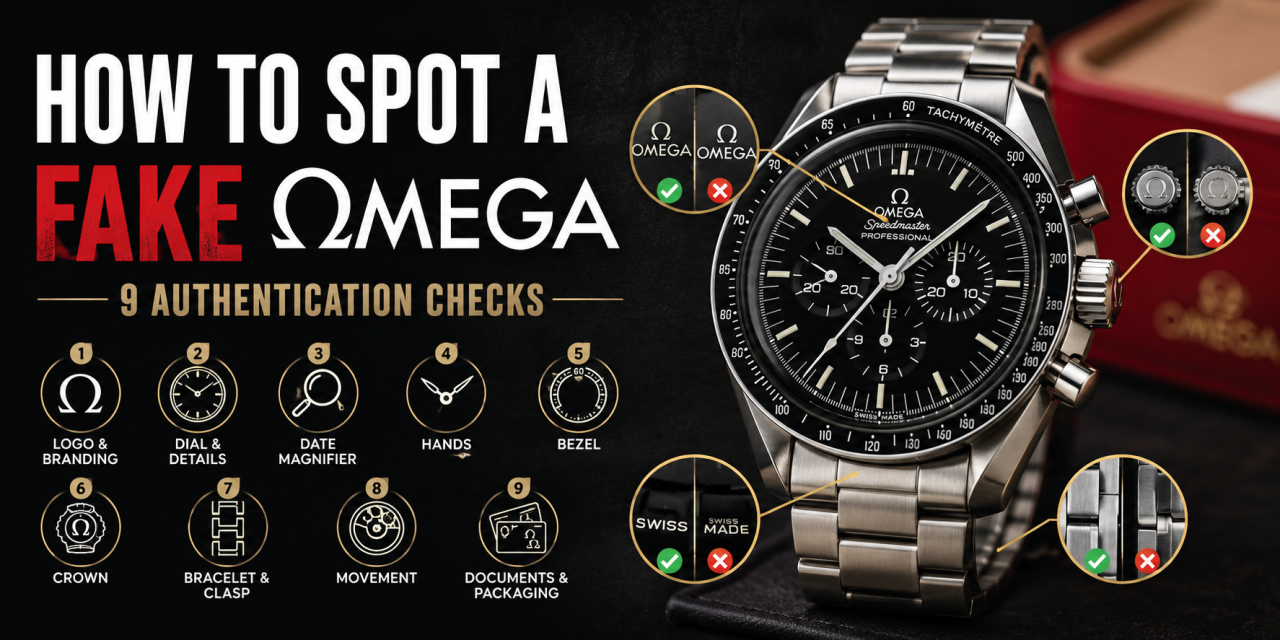
To spot a fake Omega watch, check the serial number against the movement and paperwork, look for a laser-etched Omega logo on the crystal, weigh the case (real Omegas feel dense), and listen to the second hand — it should sweep, not tick. Also inspect engraving depth on the case back, verify the movement through a transparent back if available, and confirm the reference number matches the exact model. Any single red flag is worth pausing over. Two or more, and you're almost certainly looking at a counterfeit.
Why Fake Omegas Are Getting Harder to Catch
A decade ago, spotting a fake Omega was almost insulting to the counterfeiter — cheap metal, crooked logos, a ticking second hand you could hear from across the room. That's not really the market anymore. The better replica factories have gotten good. Some "super clones" now use genuine sapphire crystal, weighted cases, and Swiss-made movements borrowed from other cheap calibers just to fake the sweep of the seconds hand.
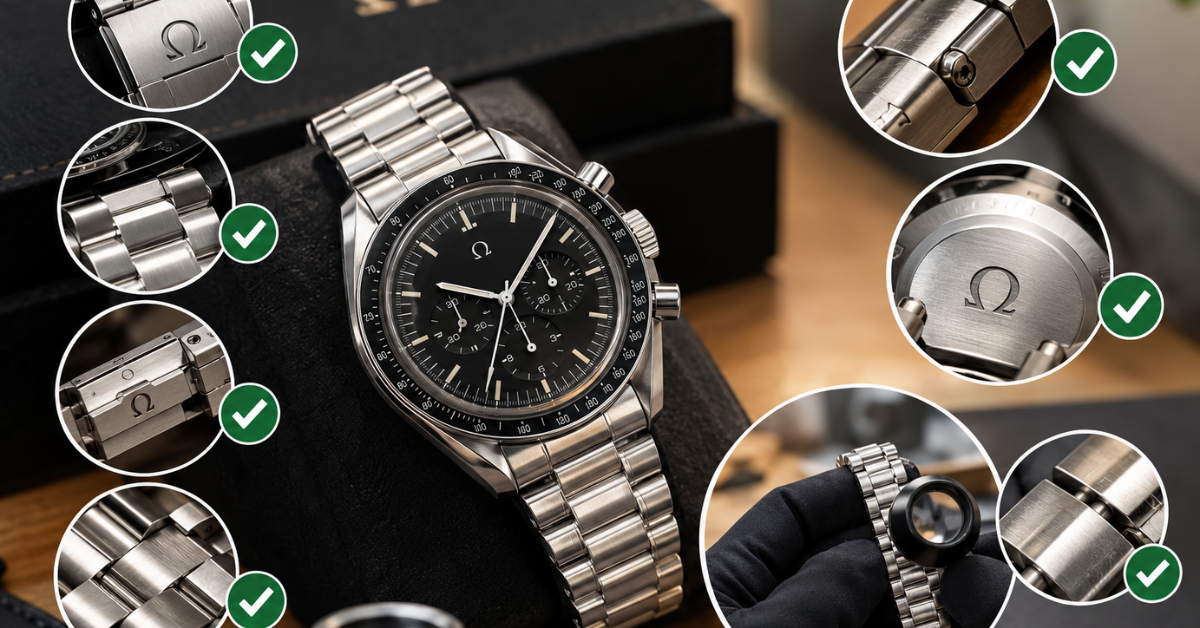
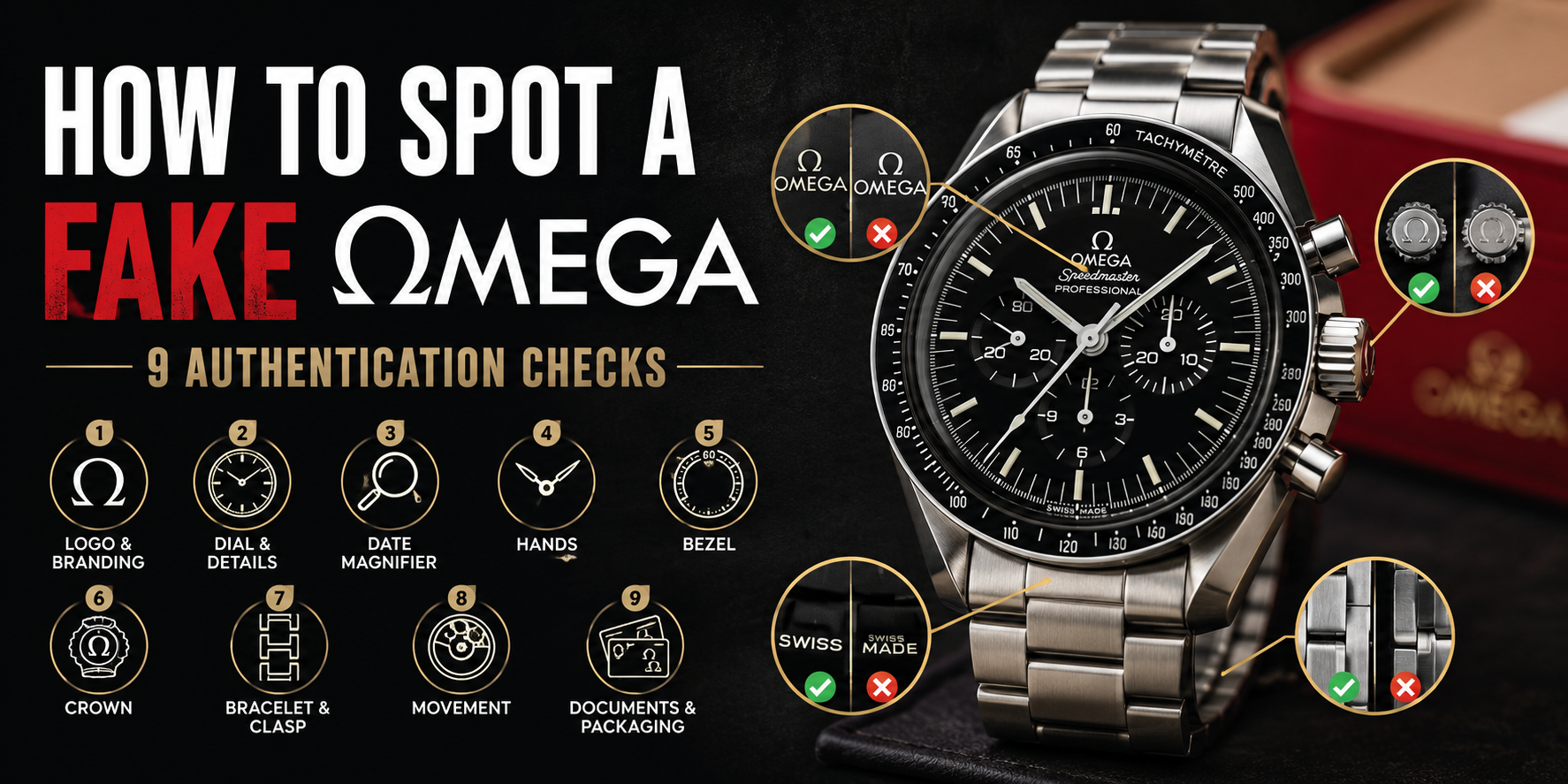
That's the uncomfortable truth: you can't rely on one obvious tell anymore. You need a handful of checks that, together, tell you what's really in front of you. Here are nine that actually hold up, whether you're buying a Speedmaster off a stranger, inheriting a vintage Seamaster, or just want to make sure the one on your wrist is what you paid for.
1. Check the Serial Number — Then Check It Again
Every genuine Omega carries a unique serial number, usually seven or eight digits depending on the era. On most current models, it's laser engraved on the underside of one of the lugs, often near the 7 o'clock position, or on the outside of the case back. Vintage pieces tend to hide it inside the case back or on the movement itself, which means you'll need the watch opened to see it.
Here's the part people miss: a serial number existing doesn't mean much on its own. Counterfeiters have gotten comfortable reusing a single valid number across thousands of fakes. So don't just look for the number — look at how it's applied. A genuine Omega serial is crisp, evenly spaced, and consistent in depth. If it looks shallow, wobbly, or slightly off in font, that's a problem. And if you can, cross-reference it against the number on the warranty card — or run it through our Omega serial number lookup by year and reference. They should match exactly.
2. Look for the Logo Etched Into the Crystal
This one's small, but it's a favorite among collectors for a reason. On many Omega models — vintage and current Speedmasters especially, along with select Seamaster, Constellation, and De Ville pieces — there's a tiny Omega logo laser-etched into the underside of the crystal, positioned just above the hands.
It's genuinely hard to see with the naked eye. Tilt the watch under a light, or grab a loupe if you have one. The mark won't always sit perfectly straight — a crooked or slightly off-center etching doesn't automatically mean fake, since Omega's own tolerances aren't laser-precise here. But its complete absence on a model that should have it? That's worth asking questions about. Worth noting: this feature isn't on every Omega reference, so check what's expected for your specific model before treating its absence as a dealbreaker.
3. Weigh It in Your Hand
This sounds unscientific, and honestly, it kind of is — but it works more often than you'd think. Omega builds its cases from solid, high-grade materials: 904L or 316L stainless steel, gold, titanium, or ceramic depending on the model. That translates into real heft. A genuine Omega on a bracelet feels substantial, almost surprisingly so if you're used to fashion watches.
Fakes, even good ones, tend to cut corners here because premium metal is expensive. Hollow links, thin case backs, a bracelet that feels tinny when you flex it — these are all signs the watch was built to look right in photos, not to survive decades on a wrist. If something feels light or hollow for its size, trust that instinct and keep digging.
4. Listen to the Second Hand
Most modern Omega calibers, including anything with the Co-Axial escapement, produce a smooth, continuous sweep of the second hand. No ticking, no jumping — just a fluid glide around the dial. A hand that visibly jumps once per second, with an audible tick, usually means there's a cheap quartz movement hiding inside a case that was never designed for one.
This isn't a perfect test on its own. Some high-end fakes now use mechanical movements borrowed from other brands, which also sweep. But a ticking second hand on a watch marketed as a mechanical Omega is about as close to a guaranteed red flag as you'll find. It fails the test instantly.
5. Inspect the Case Back Engraving
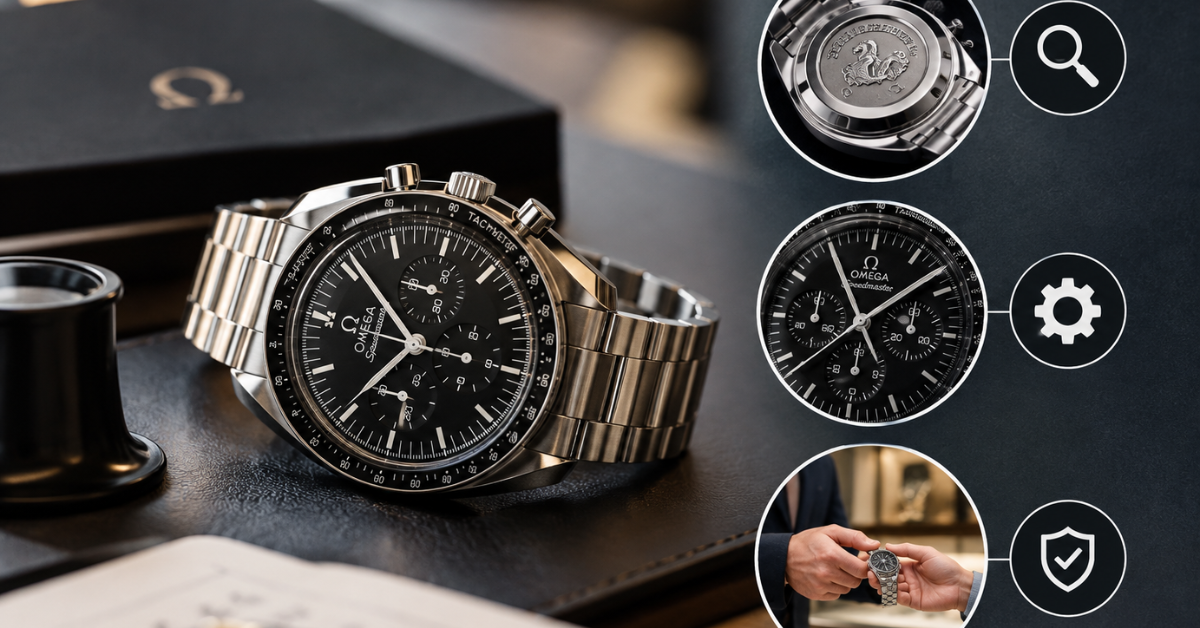
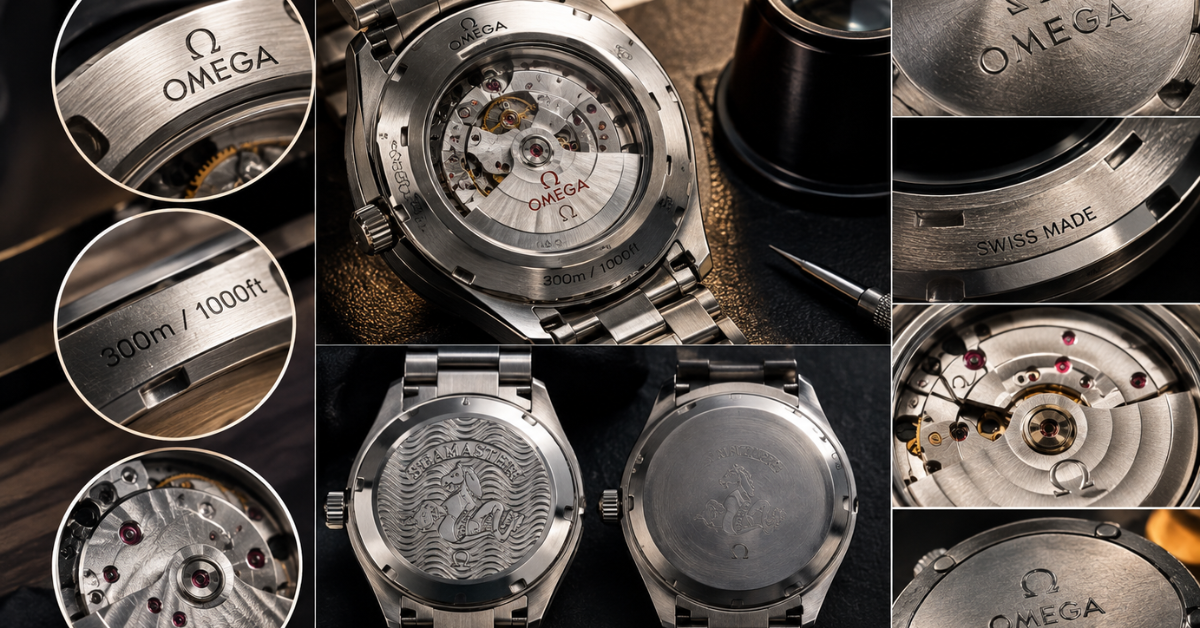
Flip the watch over. Omega's case back engravings — whether it's the Seamaster seahorse, a Speedmaster's caseback text, or a simple model reference — should be deep, crisp, and perfectly centered. Run your fingertip over it if you can; real engraving has depth you can feel, not just see.
Counterfeiters typically rely on shallow laser etching that looks fine in a listing photo but falls apart under closer inspection. Watch for blurred edges, inconsistent letter spacing, or engraving that sits slightly off-center on the case back. Genuine Omega work doesn't wobble. Every line lands exactly where it should.
6. Check the Movement, If You Can
This is the most decisive check on the list, and also the hardest to do yourself. If the watch has a transparent case back — common on Seamaster models — look at the movement directly. A real Omega movement shows Geneva stripes, polished screws, and often rhodium plating, along with the caliber number and Omega branding stamped clearly onto a bridge or rotor.
One classic tell collectors mention: on some fakes with exhibition backs, you'll spot two rotor "claws" where genuine Omega movements only ever show one. It's a small detail, but it's the kind of thing counterfeiters overlook because they're copying the look of a movement, not building the real thing. If you want the full technical picture of what a genuine caliber should look like, our guide to Omega's Co-Axial movement covers the escapement in detail. If the case back is solid and you can't see inside, this is exactly the moment to hand the watch to a professional watchmaker rather than guess.
7. Match the Reference Number to the Exact Model
Every Omega reference corresponds to specific, documented specs — case diameter, crystal type, movement, dial variant, available metals. A Speedmaster Professional Moonwatch, for instance, should measure 42mm, run on a manual-winding movement, and — if made before 2003 — use Hesalite rather than sapphire crystal.
Pull up the reference number (usually on the case back or in the paperwork) and compare it against Omega's official specs for that exact watch. If the seller's description doesn't line up — wrong crystal, wrong movement type, a complication that reference never had — you're not looking at authentication nuance anymore. You're looking at a mismatch that shouldn't exist on a genuine piece. Our Omega Speedmaster buying guide breaks down exactly what each generation of Moonwatch reference should have, if you want to check your specific model in more depth.
8. Study the Dial Under Magnification
Omega doesn't ship watches with sloppy dials. Full stop. Text should be sharp, evenly kerned, and free of any ink bleed or blur, even under a loupe. Hour markers and hands should be applied cleanly, with lume that's consistent in color and texture across the whole dial.
Fakes often get close but not quite there — a slightly wrong font weight on "Speedmaster," uneven spacing in the model name, a logo that's just a touch too thick or off-center. None of these are obvious at arm's length, which is exactly why they survive in listing photos. Pull the loupe out before you commit to anything.
9. Review the Paperwork and Packaging
A genuine Omega purchase typically comes with a warranty card, box, and documentation that follow consistent, official templates. Compare the serial number on the card against the one on the watch — they need to match precisely. Check the box for correct branding, material quality, and the kind of finish you'd expect from a company selling five-figure timepieces.
Paperwork alone won't authenticate a watch. Counterfeiters can print convincing cards. But paperwork that's missing entirely, inconsistent with the watch's serial, or printed on obviously cheap stock is one more thread to pull on. Combine it with everything above, and the picture usually gets clear fast.
What to Do If You're Still Not Sure
Even after running through all nine checks, some replicas are good enough to leave real doubt. That's not a failure on your part — the best "super clones" are built specifically to survive a casual inspection. If you're spending real money, get the watch in front of an authorized Omega dealer or an independent watchmaker who works on Swiss movements regularly. It costs a bit of time and sometimes a small fee. It's cheaper than finding out six months later that the watch you bought isn't what you thought. For a rundown of trustworthy sources, see our guide on where to buy a pre-owned Omega safely.
Frequently Asked Questions
How can I tell if my Omega serial number is real? Compare the serial engraved on the case or lug against the number on your warranty card — they should match exactly. Genuine numbers are crisp, evenly spaced, and consistently deep. Shallow, uneven, or blurry engraving is a strong sign of a counterfeit.
Do all fake Omega watches tick instead of sweep? No. Cheaper fakes with quartz movements will tick, but higher-end counterfeits now use mechanical movements that also sweep. A ticking hand is a reliable red flag, but a sweeping hand doesn't guarantee authenticity on its own.
Is a heavy watch always a real Omega? Not always, but weight is a strong indicator. Genuine Omegas use premium metals like 904L or 316L steel, gold, or titanium, which give the case real heft. A watch that feels unusually light for its size is worth further investigation.
Where is the Omega logo etched on the crystal? On models that include this feature, it sits near the center of the crystal, just above the hands. It's extremely small and often easiest to spot by tilting the watch under strong light or using a jeweler's loupe.
Can a professional always tell a fake Omega apart from a real one? An experienced watchmaker or authorized dealer catches the overwhelming majority of counterfeits, especially once the case back is opened and the movement is inspected. Against the very best super clones, even experts sometimes want more than a visual check, which is why provenance and paperwork still matter.
Should I buy an Omega from an unauthorized seller? It's riskier, though not automatically a dealbreaker if the seller has verifiable reputation and return policies. Buying from an authorized Omega dealer or a well-reviewed pre-owned specialist removes most of the guesswork and usually comes with some form of authenticity guarantee.
The Bottom Line
No single check proves a watch is real or fake on its own. What works is stacking them — serial number, crystal etching, weight, movement, engraving, paperwork — until the pattern is obvious one way or the other. Most counterfeits fail at least two or three of these tests the moment you look closely. If everything checks out and you're still unsure, that's what professional authentication is for. A few days' wait beats a permanent regret.
Reviews Editor
Sofia Marchetti
Sofia focuses on dive watches, chronographs and everyday wearability, testing every piece in real-world conditions before forming a verdict.