On this page
- The Search for One Watch That Does Everything
- At a Glance: Aqua Terra vs Explorer
- Omega Seamaster Aqua Terra 150M (41mm)
- Rolex Explorer 40 (ref. 224270)
- History: Ocean Meets Mountain
- Design: Detail vs Purity
- Omega Aqua Terra: Rich and Refined
- Rolex Explorer: Simple and Timeless
- Movement and Accuracy
- Comfort and Everyday Wear
- Durability and Water Resistance
- Price and Value for Money
- Resale Value: Rolex's Big Advantage
- Which Is the Better Everyday Watch?
- Buy the Omega Aqua Terra If...
- Buy the Rolex Explorer If...
- Other Everyday Watches to Consider
- Buying Tips
- Frequently Asked Questions
- Is the Omega Aqua Terra better than the Rolex Explorer?
- How much is the Omega Aqua Terra vs the Rolex Explorer?
- Which holds its value better, the Aqua Terra or the Explorer?
- Which is thinner, the Aqua Terra or the Explorer?
- Does the Rolex Explorer have a date?
- Is the Aqua Terra good for swimming?
- The Bottom Line
Both are excellent everyday watches, but they suit different people. The Omega Seamaster Aqua Terra 150M (41mm, about $7,100 on bracelet) has a more detailed teak-pattern dial, a display caseback, 150m water resistance and a Master Chronometer movement resistant to 15,000 gauss. The Rolex Explorer 40 (ref. 224270, $8,350) is simpler, slimmer, has a 70-hour power reserve and holds its value far better. Buy the Aqua Terra for the most watch for your money. Buy the Explorer for timeless simplicity and resale value.
The Search for One Watch That Does Everything
Many people only ever want one good watch. Something they can wear to the office on Monday, to dinner on Friday and to the beach on Sunday, without ever thinking about it.
Two watches come up again and again for that job: the Omega Seamaster Aqua Terra and the Rolex Explorer. Neither is a dive watch, neither is a dress watch, and both are designed to sit happily in between.
Which is the better everyday watch? We compared them on design, movement, comfort, durability, price and resale value. Here's how they really stack up.
At a Glance: Aqua Terra vs Explorer
Omega Seamaster Aqua Terra 150M (41mm)
- Price: about $7,100 on steel bracelet
- Case: 41mm steel, 13.2mm thick, 47.9mm lug-to-lug, 20mm lugs
- Water resistance: 150m
- Movement: Omega Co-Axial Master Chronometer calibre 8900
- Power reserve: 60 hours
- Magnetic resistance: 15,000 gauss
- Date: yes, at 6 o'clock
- Caseback: sapphire display back
- Pre-owned: about $4,000 (WatchCharts)
Rolex Explorer 40 (ref. 224270)
- Price: $8,350
- Case: 40mm Oystersteel, about 11.6mm thick
- Water resistance: 100m
- Movement: Rolex calibre 3230, Superlative Chronometer
- Power reserve: about 70 hours
- Date: no
- Caseback: solid steel
- Pre-owned: about $8,700 (WatchCharts)
Prefer something smaller? Both come in alternative sizes: the Aqua Terra in 38mm (with the calibre 8800 and a 55-hour reserve) and the Explorer in 36mm.
History: Ocean Meets Mountain
The Aqua Terra's name says it all: water and land. Omega launched it in 2002 as a refined, everyday member of the Seamaster family, built for life both on and off a boat. It quickly became Omega's go-to "one watch" recommendation. For the bigger story, read the complete history of the Omega Seamaster.
The Rolex Explorer is rooted in mountaineering. It's closely linked to the 1953 first ascent of Everest, and its design has remained famously simple ever since: black dial, bold 3-6-9 numerals, nothing extra.
Design: Detail vs Purity
Omega Aqua Terra: Rich and Refined
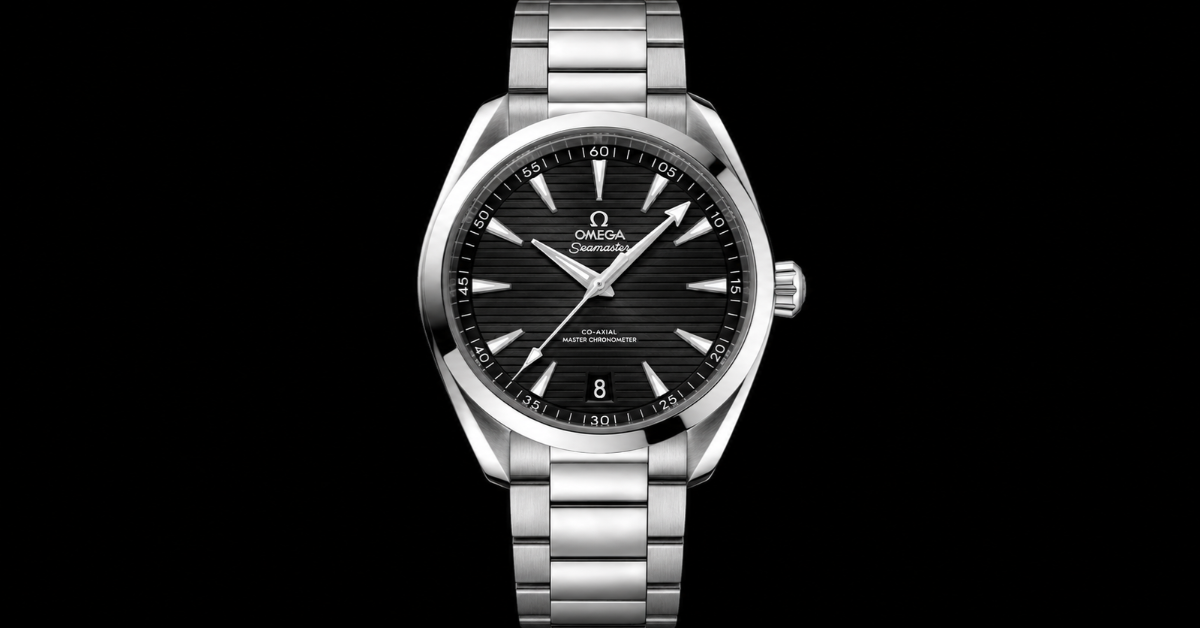
The Aqua Terra's signature is its horizontal "teak" dial, inspired by the wooden decks of luxury sailing yachts. It catches the light beautifully and gives the watch real depth. Add arrow-shaped hands, faceted markers, a date at 6 o'clock and a polished-and-brushed case, and you get a watch that looks more expensive than it is.
Flip it over and the display caseback shows off the decorated calibre 8900. It's one of the most attractive movements at this price.
Rolex Explorer: Simple and Timeless
The Explorer goes the other way. A plain black dial, 3-6-9 Arabic numerals, a smooth bezel and no date. It's one of the most understated watches Rolex makes, and that restraint is exactly why it looks right everywhere.
Verdict: if you love detail and craftsmanship you can see, the Aqua Terra wins. If you prefer a watch that never draws attention to itself, the Explorer wins.
Movement and Accuracy
- Power reserve: the Explorer wins, with about 70 hours vs the Aqua Terra's 60.
- Accuracy: both are certified to excellent standards. Rolex's Superlative Chronometer allows −2 to +2 seconds per day; Omega's METAS Master Chronometer allows 0 to +6.
- Magnetic resistance: the Aqua Terra wins clearly, certified to 15,000 gauss.
- Visibility: only the Aqua Terra lets you see the movement.
Omega's movement also uses its Co-Axial escapement, designed to reduce friction and wear. Here's how the Co-Axial escapement changed watchmaking. And because it's a Master Chronometer, you can check its official test results online. Our guide to verifying a Master Chronometer Omega shows how.
Verdict: a draw. Rolex wins on power reserve and the tighter accuracy range; Omega wins on anti-magnetism and the open caseback.
Comfort and Everyday Wear
This is where the Explorer has an edge. At about 11.6mm thick, it's noticeably slimmer than the 13.2mm Aqua Terra, so it slips under a shirt cuff more easily and feels lighter on the wrist.
The Aqua Terra isn't bulky, though. Its 47.9mm lug-to-lug keeps it wearable on most wrists, and the bracelet is comfortable and well finished.
- Wrists under 6.75 inches: consider the Aqua Terra 38mm or the Explorer 36mm.
- 6.75 to 7.5 inches: both the 41mm Aqua Terra and Explorer 40 fit well.
- Over 7.5 inches: the Aqua Terra 41mm wears with a little more presence.
Verdict: the Explorer is slightly more comfortable, mainly thanks to its slimmer case.
Durability and Water Resistance
For an everyday watch, water resistance matters more than people expect. The Aqua Terra is rated to 150m, the Explorer to 100m. Both are perfectly fine for swimming and showers, but the Aqua Terra gives you a little more margin.
Both use sapphire crystals and robust steel cases. Rolex uses its own Oystersteel, while Omega uses high-grade stainless steel. Either will handle years of daily wear.
Verdict: the Aqua Terra wins on water resistance; otherwise, both are equally tough.
Price and Value for Money
- Omega Aqua Terra 41mm: about $7,100 retail, often discounted by authorised dealers
- Rolex Explorer 40: $8,350 retail
At retail, the Aqua Terra is about $1,250 cheaper, and it gives you more for the money: a date, a display caseback, a more decorated dial, better water resistance and stronger anti-magnetism.
The Explorer is also one of the easier steel Rolexes to buy at retail right now, since its secondary market price sits close to retail.
Resale Value: Rolex's Big Advantage
- Aqua Terra 41mm: WatchCharts estimates a pre-owned value of about $3,900 to $4,000, roughly 45% below retail.
- Explorer 40: WatchCharts estimates a pre-owned value of about $8,700, slightly above retail.
That's a huge difference. If you sold both after a year, the Explorer would likely return almost all of your money, while the Aqua Terra would lose a large share of its value.
Our full analysis of Omega vs Rolex value retention explains why.
But there's a twist for buyers. Because the Aqua Terra depreciates, a lightly used one is a bargain. At around $4,000 pre-owned, you get a Master Chronometer everyday watch for less than half the price of an Explorer.
Which Is the Better Everyday Watch?
Buy the Omega Aqua Terra If...
- You want the most features and craftsmanship for your money
- You like a detailed dial and a display caseback
- You want a date window
- You want 150m water resistance and strong magnetic protection
- You're happy to buy pre-owned for an even better deal
Buy the Rolex Explorer If...
- Resale value matters to you
- You prefer a clean, timeless, no-date design
- You want the slimmest, most comfortable fit
- You value the longer 70-hour power reserve
- The Rolex name and its mountaineering history appeal to you
Our verdict: as a watch, the Aqua Terra gives you more. As an asset, the Explorer wins easily. If you'll wear it every day and keep it for years, the Aqua Terra is the smarter purchase. If you might sell it someday, the Explorer is the safer one.
Other Everyday Watches to Consider
- Omega Constellation: a dressier, integrated-bracelet alternative. Read our Constellation review.
- Omega De Ville: for a more classic dress watch. See our De Ville review and De Ville vs Constellation.
- Omega Seamaster Diver 300M: if you want a true dive watch instead. Compare it with Rolex in Omega Seamaster vs Rolex Submariner.
For a full look at the Aqua Terra on its own, read our Omega Seamaster Aqua Terra review, and for the wider range, our Omega watches buying guide.
Buying Tips
Buy either watch from an authorised dealer or a trusted pre-owned seller with a return policy. Both are frequently faked. For Omega, run through 9 checks to spot a fake Omega before you pay. And if you're buying pre-owned, ask about service history, since both watches benefit from a full service every several years. Here's how long an Omega watch really lasts.
Frequently Asked Questions
Is the Omega Aqua Terra better than the Rolex Explorer?
Neither is objectively better. The Aqua Terra offers more features for the money: a date, display caseback, 150m water resistance and 15,000-gauss magnetic resistance. The Explorer is slimmer, has a 70-hour power reserve and holds its value far better.
How much is the Omega Aqua Terra vs the Rolex Explorer?
The Omega Aqua Terra 41mm costs about $7,100 on a steel bracelet, while the Rolex Explorer 40 ref. 224270 costs $8,350 at US retail.
Which holds its value better, the Aqua Terra or the Explorer?
The Rolex Explorer holds its value much better, trading slightly above retail at about $8,700. The Omega Aqua Terra trades roughly 45% below retail, at about $3,900 to $4,000 pre-owned.
Which is thinner, the Aqua Terra or the Explorer?
The Rolex Explorer 40 is about 11.6mm thick, while the Omega Aqua Terra 41mm is 13.2mm thick. The Explorer slips under a shirt cuff more easily.
Does the Rolex Explorer have a date?
No. The Rolex Explorer is a time-only watch with no date. The Omega Aqua Terra has a date window at 6 o'clock.
Is the Aqua Terra good for swimming?
Yes. The Aqua Terra is water-resistant to 150m, so it's suitable for swimming and everyday water exposure. The Rolex Explorer is rated to 100m, which is also fine for swimming.
The Bottom Line
The Explorer is the purist's everyday watch: slim, simple and built to hold its value for decades. The Aqua Terra is the enthusiast's everyday watch: richer in detail, more capable on paper and far better value at purchase.
If you want the most watch for your money, choose the Aqua Terra. If you want a watch that quietly keeps its worth, choose the Explorer. Either way, you'll have one of the best everyday watches made.
Editor-in-Chief
Editorial Team