On this page
- Where Each One Actually Comes From
- Design: A Signature Look vs. Deliberate Restraint
- Case Sizes and Wearability
- Movement and Engineering: Genuinely on Par
- Pricing: Real Overlap, Different Entry Points
- Water Resistance: A Real Practical Difference
- So, Which One Actually Wins?
- Buying With Confidence
- FAQ
- Conclusion
The Omega De Ville and Constellation are both Master Chronometer-certified dress watches, but they pursue genuinely different design philosophies. The De Ville is Omega's purest, quietest expression of classical dress watchmaking — thin, understated, with Prestige models starting around $4,200. The Constellation carries a distinctive signature look — the claw-shaped lugs gripping the crystal and an integrated bracelet feel — positioned higher, with steel Manhattan models starting around $6,000 to $7,600. Neither "wins" outright; the Constellation suits buyers who want a recognizable design identity, while the De Ville suits buyers who want a dress watch that disappears quietly under a cuff.
Omega doesn't really have one dress watch — it has two, built on genuinely different ideas of what a dress watch should do. The De Ville aims for quiet, restrained classicism with no gimmicks. The Constellation aims for a confident, recognizable design signature that still reads as formal. Both wear the same Master Chronometer engineering underneath, which makes this less a quality comparison and more a question of which design philosophy you actually want on your wrist.
Where Each One Actually Comes From
The Constellation has the older, more decorated pedigree of the two. Omega launched it in 1952 specifically as a flagship precision timepiece, built to showcase the brand's chronometer achievements at a time when timekeeping accuracy was Omega's primary competitive claim. That original purpose still shapes the collection's identity today — it's Omega's watch built to say "we take precision seriously," not just "this looks nice."
The De Ville's origin is more understated, fittingly. It started in 1960 as part of the Seamaster line, spun off into its own standalone collection by 1967 once its more streamlined, elegant design proved it didn't belong grouped with Omega's sports watches. It went on to rack up genuine engineering firsts of its own — a 1999 De Ville became the first Omega watch ever equipped with a Co-Axial movement, and the 2007 De Ville Hour Vision introduced the in-house Caliber 8500 that shaped a new generation of Omega movements. Our full De Ville review covers that engineering history in more depth, alongside the current Prestige, Trésor, and Tourbillon lineup.
Design: A Signature Look vs. Deliberate Restraint
This is the real heart of the comparison, and it's worth being direct about it: these two watches are trying to do different things on the wrist.
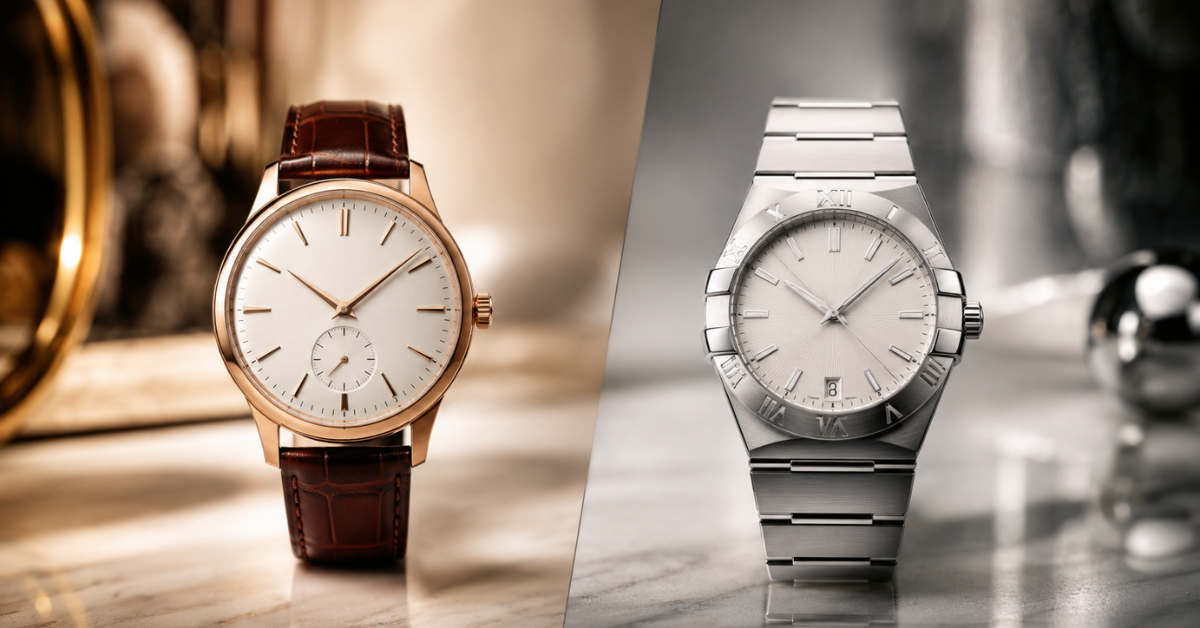
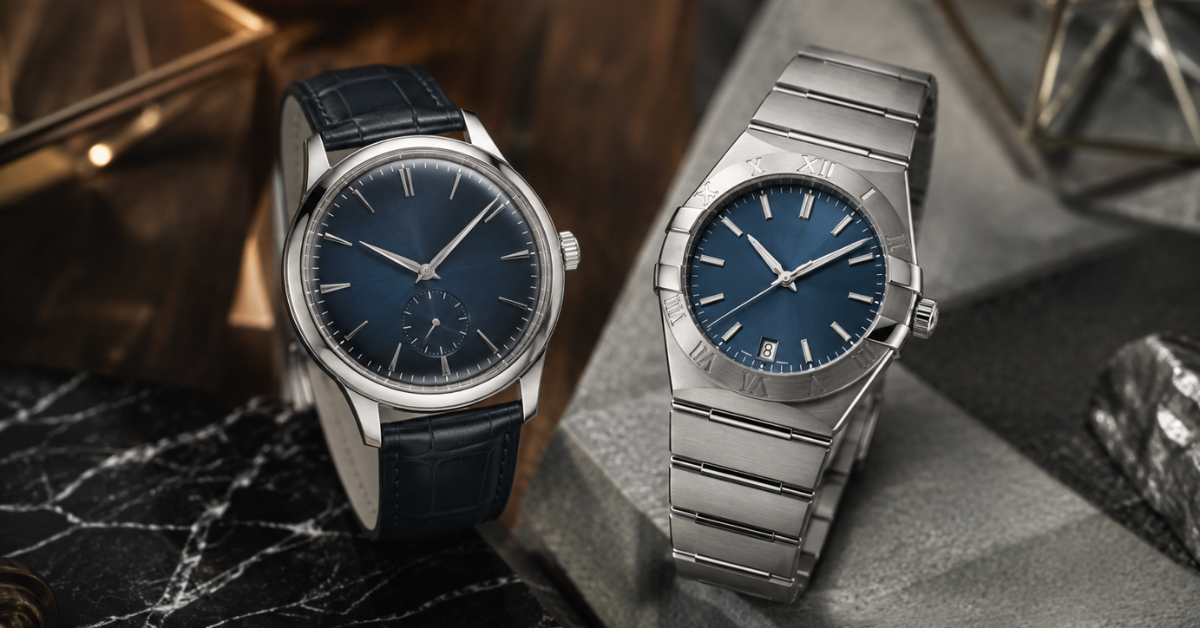
The Constellation's defining visual element is its claw-shaped lugs — griffes, in Omega's own terminology — that visibly grip the crystal at four points, paired with a case and bracelet designed to flow as one continuous unit. It's a genuinely distinctive silhouette, instantly identifiable even to people who don't follow watches closely, and it gives the Constellation what our own review described as real visual authority on the wrist. Ceramic bezel options with Liquidmetal Roman numerals add a further layer of material distinction available on higher configurations. Our Constellation review covers the current Manhattan line and the newer Observatory tier in full.
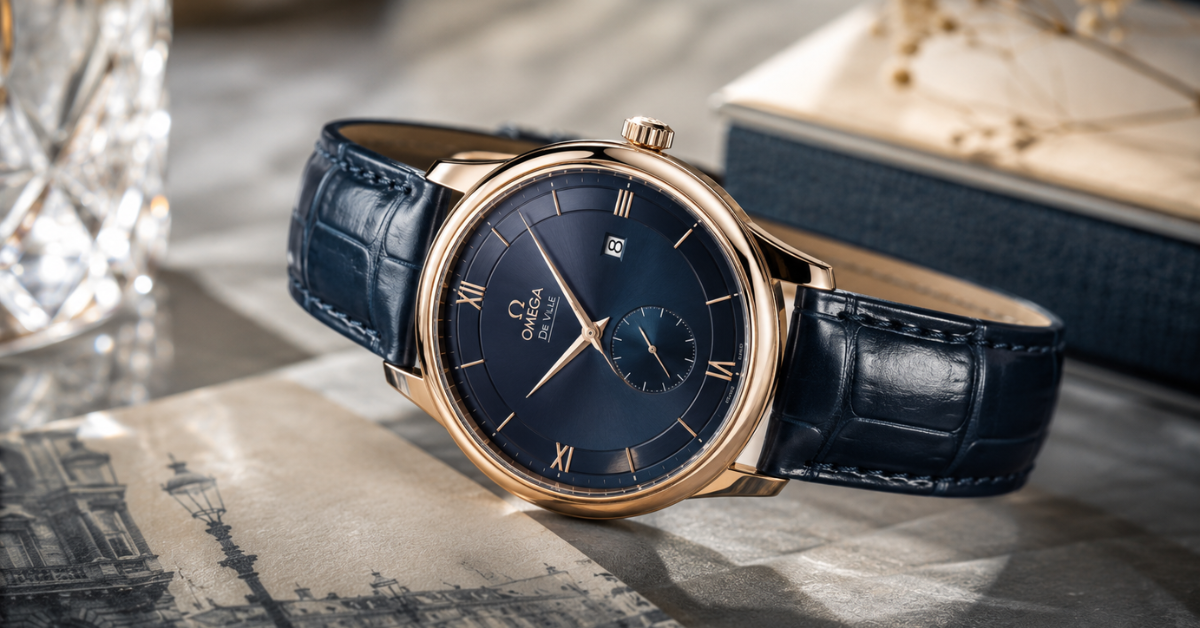
The De Ville pursues the opposite instinct entirely. No claws, no integrated bracelet signature, no design element built to be recognized from across a room — just a thin, classically proportioned case meant to disappear quietly under a dress shirt cuff. If the Constellation is Omega saying something about precision and design confidence, the De Ville is Omega choosing to say nothing at all, which is its own kind of statement for buyers who specifically want that restraint.
Case Sizes and Wearability
The Constellation offers the broader range by a wide margin, spanning from 25mm up through 41mm — genuinely covering everything from smaller women's references to larger men's models within one collection, which is unusually wide for a single dress watch line. The De Ville's Prestige models run from 34mm to 41mm, a real range of its own, but narrower and more consistently positioned toward traditional men's dress-watch proportions throughout.
Both prioritize wearability under a cuff, though the De Ville's thinner, purely classical case profile generally sits closer to the wrist than the Constellation's more structurally distinctive case-and-bracelet design.
Movement and Engineering: Genuinely on Par
This is where the comparison stops being about winners and losers. Both collections run Omega's Co-Axial Master Chronometer movements, independently METAS-certified for 15,000-gauss magnetic resistance and precision to 0/+5 seconds a day. The Constellation's Manhattan line runs Caliber 8900 in the 41mm and Caliber 8800 in the smaller 39mm, the latter delivering a 55-hour power reserve; the De Ville runs closely comparable current-generation calibers across its own lineup. Neither watch is meaningfully better engineered than the other — you're choosing a design philosophy, not a tier of movement quality.
Pricing: Real Overlap, Different Entry Points
The De Ville Prestige starts lower, generally around $4,200, making it the more accessible entry point into Omega's Master Chronometer dress-watch engineering. The Trésor, De Ville's ultra-thin variant, starts around $4,700. The Constellation's entry point sits meaningfully higher — steel Manhattan models generally start around $6,000 to $7,600, with the newer Constellation Observatory tier climbing past $10,900.
At the top of each collection, both climb considerably further — the De Ville Tourbillon and Constellation's precious-metal and diamond-set configurations both move well beyond the core steel pricing discussed above, into a different conversation entirely from either collection's accessible tier.
Water Resistance: A Real Practical Difference
Worth flagging plainly: neither watch is built for water exposure, but the gap between them still matters. The De Ville carries just 30 meters of water resistance — strictly an office-and-dinner watch, not something to wear in the shower or pool. The Constellation generally offers somewhat more robust everyday resistance thanks to its sportier case construction, though still well short of what you'd want for genuine swimming. If versatility beyond formal settings matters to you, neither is the right pick — our Aqua Terra review covers a genuinely more water-capable Omega built specifically for that kind of dress-to-casual crossover.
So, Which One Actually Wins?
Neither, honestly — and treating this as a contest with one correct answer misses what actually separates them. Choose the Constellation if you want a dress watch with genuine design personality, a broader size range to fit almost any wrist, and don't mind starting your Omega dress-watch journey a bit higher on price. Choose the De Ville if you want the most restrained, classically proportioned dress watch Omega makes, at a meaningfully lower entry price, with no design element competing for attention.
If long-term ownership costs factor into your decision either way, our piece on how long an Omega watch actually lasts covers the Co-Axial escapement's service-interval advantage, which applies equally to both collections.
Buying With Confidence
Whichever collection you choose, buying from an authorized source removes any authentication risk. Our guide on how to spot a fake Omega watch covers the checks worth running before any pre-owned purchase.
FAQ
Which is more expensive, the Omega De Ville or Constellation? The Constellation generally starts higher, with steel Manhattan models around $6,000 to $7,600, compared to the De Ville Prestige's roughly $4,200 entry point.
What's the main design difference between the De Ville and Constellation? The Constellation has a distinctive signature look built around claw-shaped lugs and an integrated bracelet feel, while the De Ville pursues deliberately restrained, classical dress-watch design with no comparable signature element.
Do the De Ville and Constellation use the same movement quality? Yes — both run Omega's Co-Axial Master Chronometer movements, independently METAS-certified for the same 15,000-gauss magnetic resistance and precision standard.
Which Omega dress watch has more size options? The Constellation offers a broader range, spanning 25mm to 41mm across the collection, compared to the De Ville Prestige's 34mm to 41mm range.
Can I swim or shower with either watch? No — the De Ville's 30-meter water resistance and the Constellation's similarly limited rating make both strictly formal, office-and-dinner watches rather than everyday all-purpose pieces.
Conclusion
The De Ville and Constellation aren't competing for the same buyer so much as offering two different answers to what a dress watch should be. One leans into a confident, recognizable design signature at a higher starting price; the other leans into pure, quiet restraint at a more accessible one. Both back that choice with genuinely equivalent Master Chronometer engineering — so the real decision comes down to which philosophy actually matches how you want to show up in a room, not which watch is objectively better.
Editor-in-Chief
Editorial Team