On this page
- History and Milestones
- 1932 — The Marine: Where Omega's Diving Story Actually Begins
- 1948 — The First Seamaster: Born From Wartime Engineering
- 1957 — The Seamaster 300: Omega's First True Professional Diver
- 1993 — The Diver 300M and the Wave Dial
- 1995 — James Bond's Watch of Choice
- 2014 — The 15,000 Gauss Breakthrough
- 2018 — The Modern Diver 300M Redesign
- 2019 — The Seamaster Ultra Deep
- The Seamaster Family Today
- Why This History Actually Matters to Buyers
- Buying With Confidence
- FAQ
- Conclusion
The Omega Seamaster launched in 1948 to mark Omega's 100th anniversary, built on waterproof military watch technology developed for the British Royal Navy during World War II. Its roots trace back further to 1932 and the Omega Marine, the first watch specifically designed for civilian divers. The Seamaster evolved from an elegant water-resistant dress watch into a dedicated dive tool with the 1957 Seamaster 300, then became globally recognized as James Bond's watch of choice starting in 1995's GoldenEye. It remains Omega's longest-running collection still in production today.
History and Milestones
1932 — The Marine: Where Omega's Diving Story Actually Begins
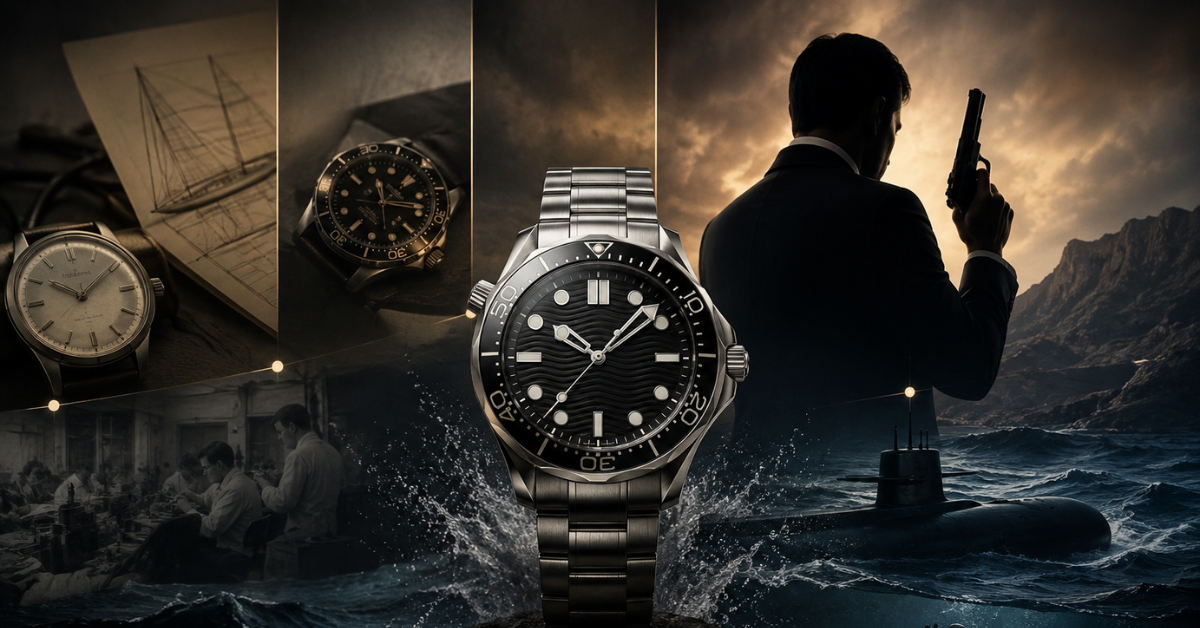
Before there was a Seamaster, there was the Marine — the watch that started Omega's entire relationship with underwater engineering. Released in 1932, it's recognized as the first watch specifically designed for civilian divers, built with a pioneering water-resistant construction well ahead of its time. It wasn't a marketing exercise: French Navy officer Yves Le Prieur, credited as the inventor of the modern scuba mask and tank, wore the Marine, and in 1936 explorer Charles William Beebe tested it during a bathysphere descent to 14 meters off the coast of Bermuda. That's genuine, documented field use, not a brand claim dressed up as heritage.
1948 — The First Seamaster: Born From Wartime Engineering
Omega launched the original Seamaster in 1948, timed deliberately to coincide with the brand's 100th anniversary. Its design drew directly on waterproof military wristwatches Omega had developed for the British Royal Navy during World War II — Omega looked to the resilient rubber gaskets used in wartime submarines for inspiration, replacing the lead or shellac seals that earlier water-resistant watches relied on, which degraded easily under temperature changes. The result was a case that held its water resistance to 60 meters and withstood temperatures ranging from -40°C to 50°C, a genuine engineering advance for a mainstream civilian watch at the time.
Worth being precise about what the original Seamaster actually was: not yet a dedicated dive tool, but an elegant, water-resistant watch built for what Omega itself described as "town, sea and country" — equally suited to a boardroom or a boat deck. That versatility, present from the very first reference, is arguably the throughline connecting every Seamaster sub-collection that followed.
1957 — The Seamaster 300: Omega's First True Professional Diver
Nearly a decade after the original launch, rising demand from military and recreational divers pushed Omega to build a genuinely purpose-designed dive tool. The Seamaster 300, reference CK2913, arrived in 1957 as Omega's first watch engineered specifically for professional diving — broad arrow hands, applied luminous markers, and water resistance built for real underwater work rather than everyday splash protection. Omega revived this exact design in 2014 as a modern Master Chronometer reissue, staying remarkably faithful to the 1957 original's dial layout and proportions. Our full Seamaster 300 review covers that modern reissue in detail, including how it compares to Omega's more contemporary diver.
1993 — The Diver 300M and the Wave Dial
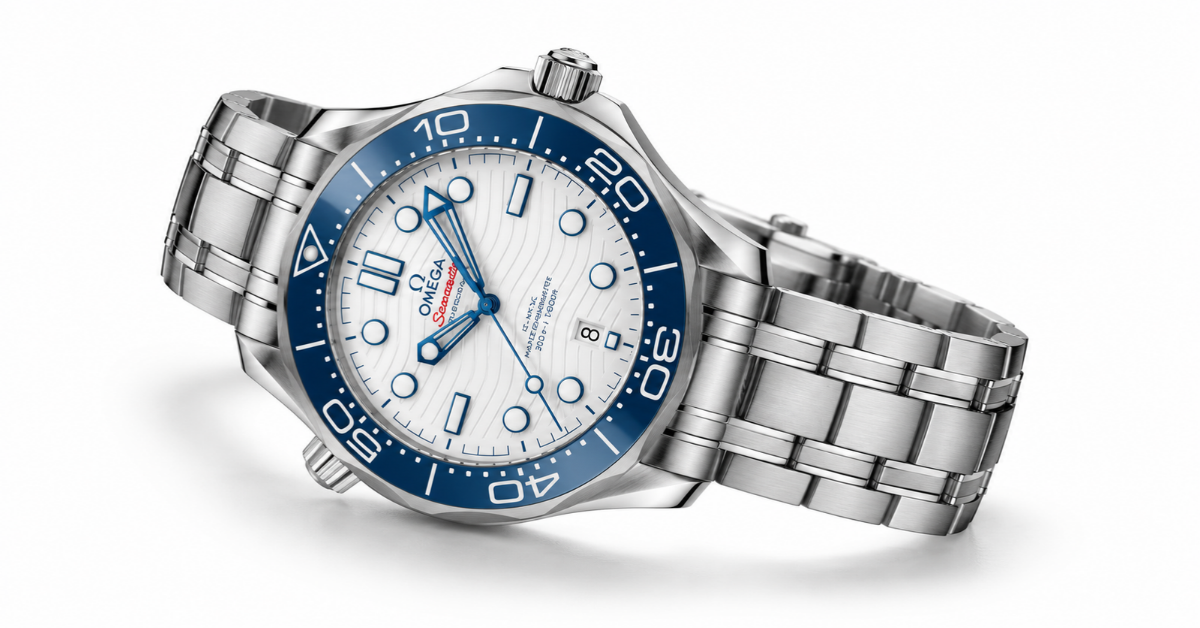
The Seamaster line that most people picture today — wave-pattern dial, ceramic bezel, helium escape valve — traces to 1993 and the introduction of the Seamaster Diver 300M. It represented a deliberate modernization of Omega's dive-watch design language, distinct from the more historically faithful Seamaster 300, and it's the reference that would go on to define the collection's public identity for the next three decades. Our Seamaster Diver 300M review covers how that original 1993 design has evolved into the current generation.
1995 — James Bond's Watch of Choice
This is the milestone most responsible for the Seamaster's global name recognition, and it's worth being specific about when and how it happened. The Diver 300M made its film debut on Pierce Brosnan's wrist in GoldenEye in 1995, replacing the Rolex Submariner that had been associated with the character since the franchise began. Omega has remained the franchise's official watch partner in every Bond film since, through Brosnan, Daniel Craig, and beyond — a three-decade partnership that's arguably done more to shape the Seamaster's public identity than any single piece of watchmaking innovation on this list.
2014 — The 15,000 Gauss Breakthrough
A genuinely significant, if less publicly celebrated, engineering milestone: in 2014, Omega introduced the Seamaster Aqua Terra >15,000 Gauss, at the time the world's most anti-magnetic mechanical watch. Rather than relying on a protective inner case to shield the movement from magnetic interference — the traditional solution — Omega's Caliber 8508 achieved that resistance through non-ferrous materials built directly into the movement itself, developed jointly by ETA, Asulab, Nivarox FAR, and Omega's own engineers. This is the technology that directly evolved into the Master Chronometer certification standard found across Omega's current Seamaster lineup, independently verified by METAS to resist magnetic fields up to 15,000 gauss.
2018 — The Modern Diver 300M Redesign
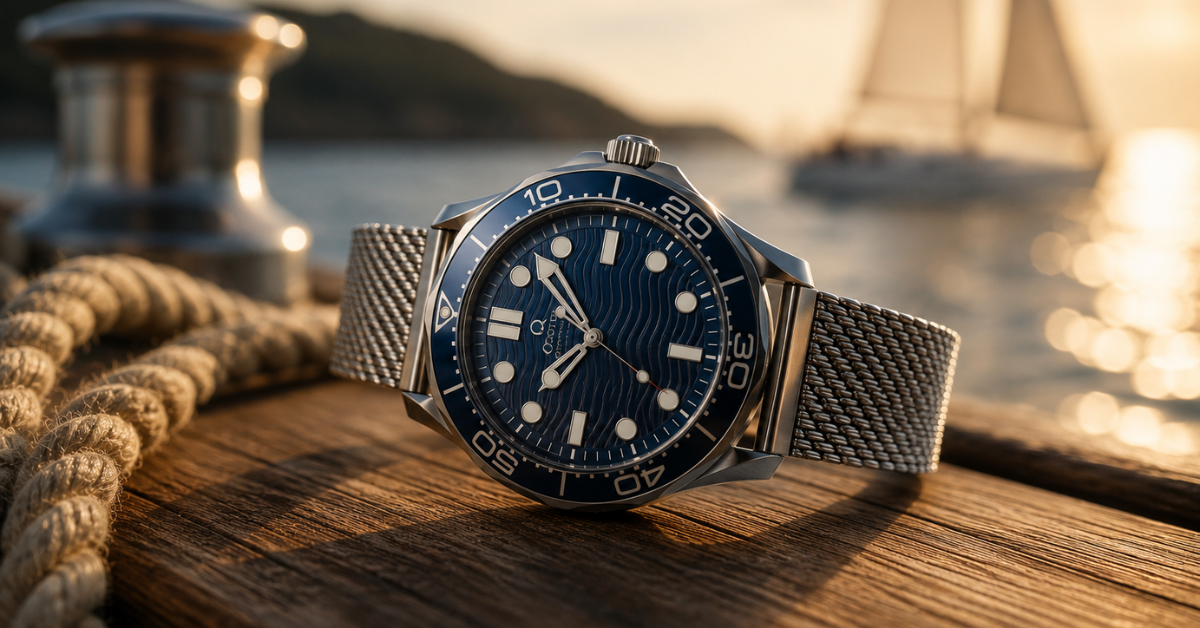
For the Diver 300M's 25th anniversary, Omega returned to the wave-pattern dial with meaningful modern updates — polished ceramic construction, a finer, laser-patterned wave texture, and the date window relocated from 3 o'clock to 6 o'clock for better dial symmetry. The movement changed too, moving to the in-house Caliber 8800, 8801, and 8900 (the latter for chronograph references), all carrying Master Chronometer certification — a considerably stricter standard than the chronometer certification the Diver 300M carried in its earlier generations.
2019 — The Seamaster Ultra Deep
The Seamaster name went further underwater than any watch in the collection's history when it took part in a record-setting dive to the deepest known point on Earth — genuine proof that the engineering lineage started by the 1932 Marine hadn't just continued, but kept advancing toward its original purpose.
The Seamaster Family Today
What started as a single 1948 reference has grown into several genuinely distinct sub-collections, each carrying forward a different piece of that original "town, sea and country" identity:
- Seamaster 300 — the historically faithful heritage diver, reviewed in full here
- Diver 300M — the modern, Bond-associated design, reviewed here
- Planet Ocean — Omega's more technically serious professional dive tool, with 600m water resistance and a helium escape valve, reviewed here
- Aqua Terra — the versatile, dressier sibling that arguably carries the original 1948 "town and country" spirit most directly, reviewed here
If you're trying to decide between the Seamaster and Omega's other major sports line, our Speedmaster vs Seamaster comparison covers how the two collections actually differ in daily use, beyond just their separate origin stories.
Why This History Actually Matters to Buyers
None of this is trivia for its own sake. The Seamaster's current engineering — Master Chronometer certification, 15,000-gauss magnetic resistance, genuine multi-hundred-meter water resistance — traces in a direct, documented line back to real innovations solving real problems, starting with a 1932 watch built for actual divers and a 1948 gasket borrowed from wartime submarine engineering. That's a different kind of credibility than a brand simply asserting quality, and it's part of why the collection has remained in continuous production longer than anything else in Omega's current catalog. If you're weighing how that engineering lineage translates into long-term durability, our piece on how long an Omega watch actually lasts covers what that history means for a watch you're buying today.
Buying With Confidence
Given the Seamaster's decades of recognition and its Bond association specifically, it remains a frequent counterfeit target. Buying from an authorized source removes that risk entirely—our guide on how to spot a fake Omega watch covers the nine checks worth running before any purchase, and our Omega Watches Buying Guide covers how to navigate the full Seamaster lineup and the rest of Omega's current catalog.
FAQ
When was the Omega Seamaster first introduced? 1948, timed to coincide with Omega's 100th anniversary, built on waterproof military watch technology developed for the British Royal Navy during World War II.
What's the difference between the Omega Marine and the Seamaster? The Marine, released in 1932, was Omega's first dedicated diver's watch and predates the Seamaster by 16 years; the Seamaster launched in 1948 as a broader "town, sea and country" watch that only became a purpose-built professional dive tool with the Seamaster 300 in 1957.
When did James Bond start wearing an Omega Seamaster? 1995, when Pierce Brosnan wore the Seamaster Diver 300M in GoldenEye, beginning a partnership that has continued through every Bond film since.
What makes the current Seamaster Diver 300M different from the original 1993 version? The 2018 redesign introduced a polished ceramic wave dial with a finer laser-patterned texture, relocated the date window from 3 to 6 o'clock, and moved to the in-house Caliber 8800/8801/8900 with Master Chronometer certification.
Is the Seamaster Omega's oldest watch collection? Yes — it's the longest-running collection still in production today, having launched in 1948 and remained continuously part of Omega's catalog ever since.
Conclusion
The Seamaster's story doesn't start with James Bond, even though that's the association most people know it by — it starts with a 1932 dive watch tested at real depth by real explorers, and a 1948 gasket borrowed from wartime submarine engineering. Everything since, from the 1957 Seamaster 300 to the 2014 magnetic-resistance breakthrough to the modern Diver 300M, has been a continuation of that same original engineering problem: building a watch genuinely capable of going where its wearer goes, in water or out of it.
Features Writer
Daniel Cho
Daniel writes about watch design, collecting and the culture around horology, with a soft spot for tool watches and honest value.