On this page
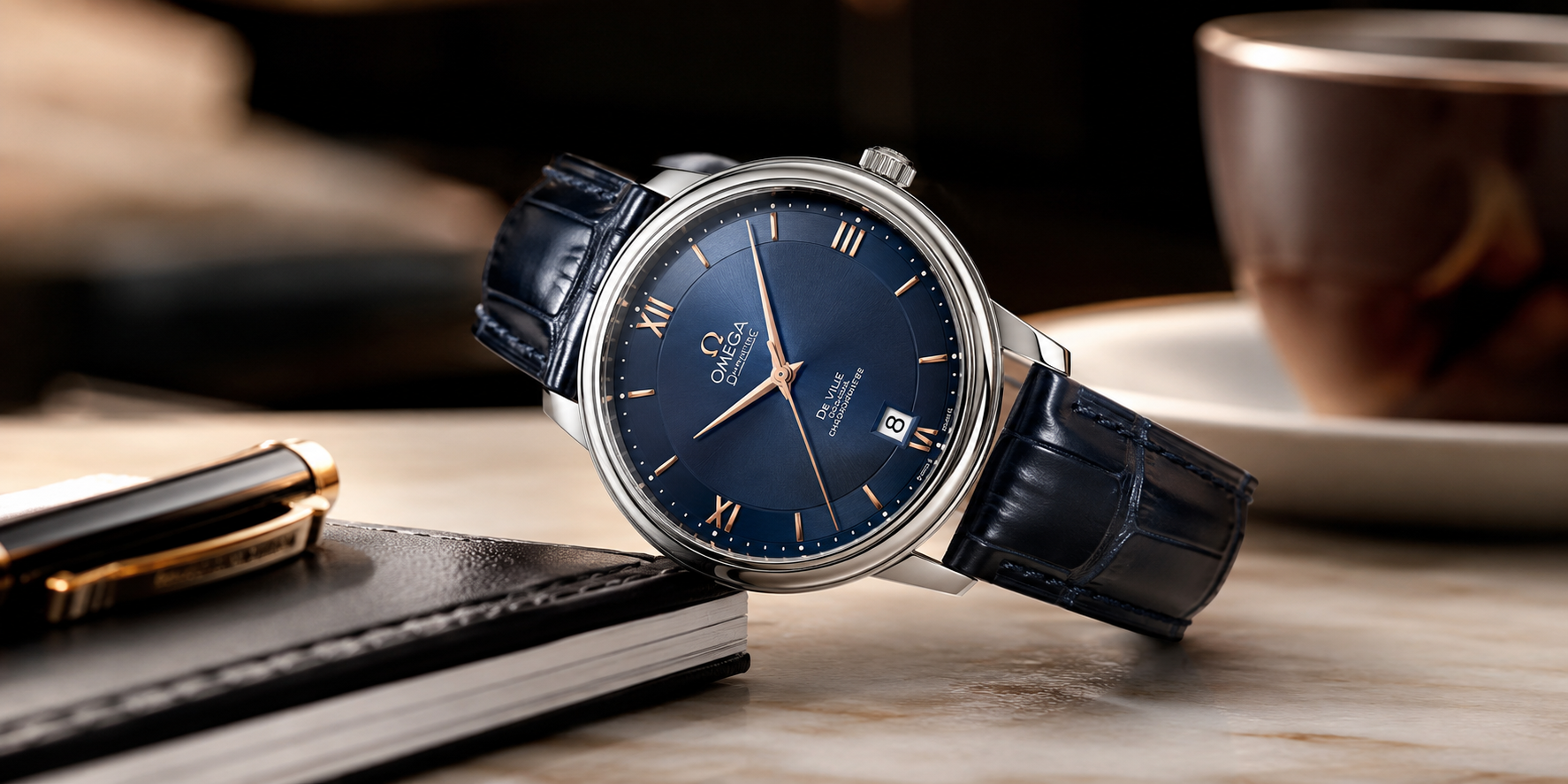
The Omega De Ville is Omega's dress watch collection, split mainly into the De Ville Prestige (from around $4,200), the ultra-thin De Ville Trésor (from around $4,700), and the De Ville Tourbillon at the top of the range. Most current models run the Co-Axial Master Chronometer movement, METAS-certified for 15,000-gauss magnetic resistance and 0/+5 seconds a day accuracy. For a formal, everyday-wearable dress watch with real Omega engineering underneath, it's one of the strongest options under $10,000 — though the 30m water resistance means it's strictly an office-and-dinner watch, not an everything watch.
Introduction
Omega's Speedmaster gets the headlines. The Seamaster gets the divers. And the De Ville? It quietly does the job nobody talks about — looking sharp under a cuff. If you've been circling this Omega De Ville review because you want something that doesn't scream "tool watch" the moment you walk into a boardroom, you're in the right place. We spent time with the current Prestige and Trésor references to figure out where the De Ville actually earns its keep, and where it doesn't.
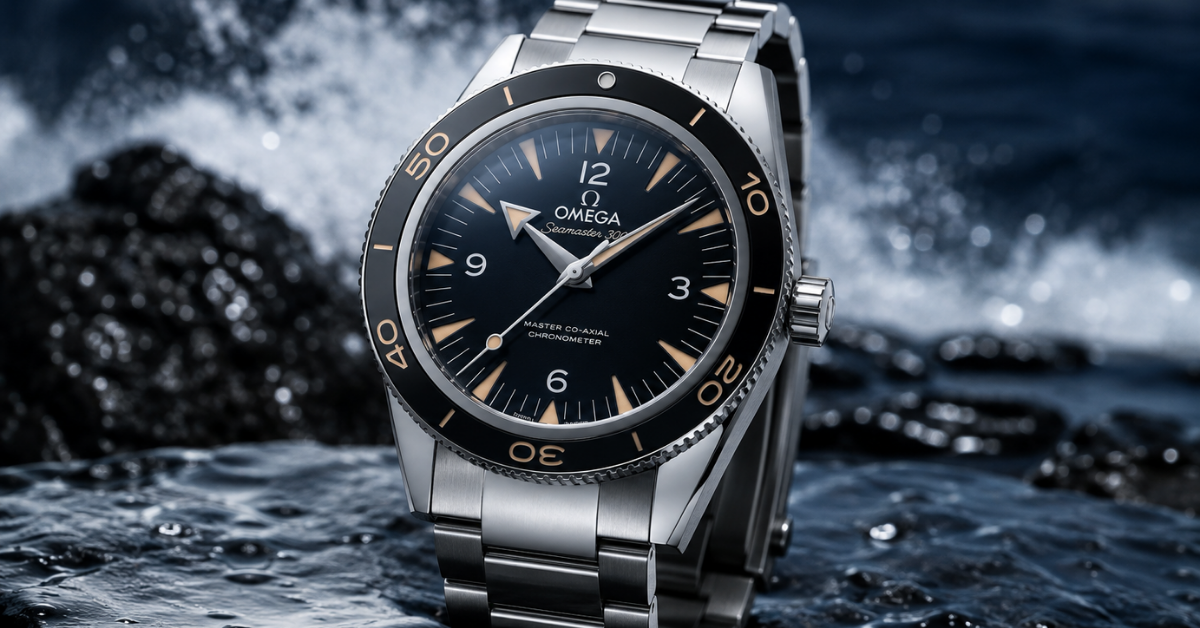
This isn't a press release rewrite. We've also reviewed the Seamaster Diver 300M and the Constellation on this site, and honestly, the De Ville sits in a different category from both. It's not trying to be versatile. It's trying to be correct.
What Is the Omega De Ville, Exactly?
De Ville means "of the city" — and that's the whole design brief. Where the Seamaster and Speedmaster trace back to diving and racing, the De Ville has always been Omega's answer to the classic dress watch: thin, round, unfussy, meant to disappear under a shirt sleeve.
The name dates back to the 1960s, when Omega used it as a line within the Seamaster family before spinning it into its own collection. These days it covers three main sub-families, and they're different enough that lumping them together does a disservice to all three.
De Ville Prestige
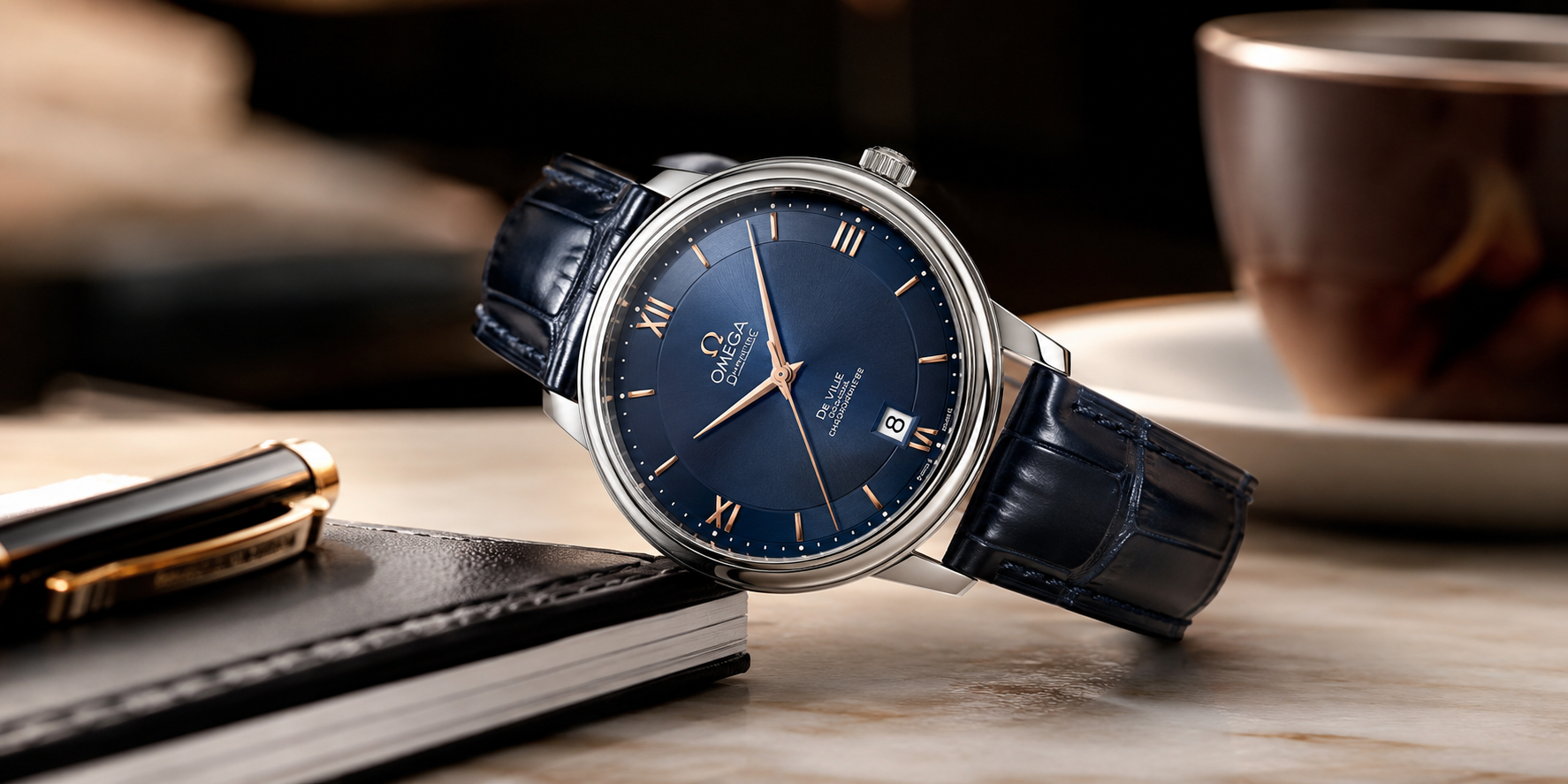
This is the volume seller, and for most people, it's the one worth focusing on. Cases run 34mm to 41mm, so there's a genuine range for smaller and larger wrists — something a lot of dress watches get wrong by only offering one size. The 39.5mm is the one we'd point most men toward. It sits close to the wrist, reads as formal without looking dainty, and works equally well with a suit cuff or a rolled-up shirt sleeve on a Friday.
De Ville Trésor
Trésor is French for "treasure," and this is Omega leaning hard into old-school elegance. It's noticeably thinner than the Prestige — some references sit under 7mm thick — with a manually wound or automatic Co-Axial movement depending on the reference. If the Prestige is a great dress watch, the Trésor is closer to a statement piece. Fewer complications, cleaner dial, and a case that's genuinely built to slide under a cuff without a bulge.
De Ville Tourbillon
At the top sits the Tourbillon, which is less a competitor to the Rolex Cellini crowd and more Omega showing what its watchmakers can actually do. Limited production, a visible tourbillon complication, and pricing that puts it in a completely different conversation from the other two. Most buyers reading this review aren't shopping here — and that's fine, because the Prestige does 90% of what people actually want from a De Ville.
Design and Build
Pick up a De Ville Prestige and the first thing you notice is how quiet it is. No date wheel fighting the dial symmetry on most references, clean baton or Roman numeral markers, and a case that tapers nicely into the lugs instead of just stopping. Omega didn't try to reinvent anything here — and honestly, that restraint is the point.
The dials come in sunburst finishes, mother-of-pearl on the smaller ladies' references, and the occasional guilloché pattern on higher-tier pieces. It photographs well, but it's actually better in person — the sunburst effect catches light in a way product shots don't fully capture.
Where it loses points: the bracelet options aren't as strong as the Seamaster's. Most De Ville models lean on leather straps, which look great but mean more upkeep than a steel bracelet. If you want a dress watch you can wear daily without babying a strap, budget for a spare or two.
Movement and Accuracy
Here's where the De Ville genuinely competes above its price class. Current Prestige and Trésor references run Omega's Co-Axial Master Chronometer calibers — the same movement family found in Seamasters and Speedmasters costing considerably more.
That gets you:
- METAS certification for resistance to magnetic fields up to 15,000 gauss
- Chronometer-grade accuracy of 0 to +5 seconds per day
- A co-axial escapement that reduces friction and stretches service intervals out to 8–10 years, versus 5–7 for a lot of conventional Swiss movements
That last point matters more than people give it credit for. Longer service intervals mean lower total cost of ownership, and that's a real advantage against dress watches from Cartier or Jaeger-LeCoultre in the same price bracket, which often need servicing more frequently.
Some entry Trésor references still ship with quartz movements. That's not a flaw exactly — it keeps the price accessible — but if the Co-Axial movement is part of why you're buying Omega in the first place, double check the reference before you buy.
Pricing: What You'll Actually Pay
Retail pricing on the De Ville Prestige starts around $4,200 to $5,500 for steel Co-Axial references, climbing well past $10,000 once you move into gold or two-tone cases. The Trésor sits in similar territory, generally $4,700 and up depending on dial and case material. Tourbillon pricing is a different world entirely and isn't really comparable.
On the secondary market, De Ville pricing has actually held up reasonably well — better than brand average by some tracking, according to data from watch marketplaces monitoring recent sales. That's a bit surprising for a dress watch, since these tend to depreciate faster than sports models. It suggests demand is steadier than the De Ville's lower profile would suggest.
For buyers weighing the De Ville against other Omega lines at similar money, our best Omega watches under $5,000 guide and the under $20,000 roundup both cover where it lands relative to the rest of the catalog.
Who Should Buy the Omega De Ville
If your watch needs are "looks right with a suit," the De Ville Prestige is close to the obvious answer in Omega's lineup. It's formal without being fussy, the movement is genuinely excellent for the money, and 39.5mm wears comfortably on most wrists.
It's not for you if you need one watch that does everything. Thirty meters of water resistance means no swimming, no serious water exposure, nothing beyond an accidental splash at the sink. If that's a dealbreaker, the Seamaster Diver 300M is a better fit for daily versatility.
And if you're buying secondary market — which, given De Ville pricing, a lot of people will — it's worth running through our guide on how to spot a fake Omega first. Dress watches like the De Ville get counterfeited just as often as the sports lines, sometimes more, because the simpler dial design is easier to fake convincingly.
Omega De Ville vs. the Competition
Against a Cartier Tank or a JLC Master Ultra Thin, the De Ville's case for itself comes down to the movement. You're getting METAS certification and a Co-Axial escapement at a price where competitors are often still running standard Swiss automatics with shorter service intervals. What you give up is some of the brand cachet — Cartier's design language is arguably more recognizable, and that matters to some buyers more than movement specs ever will.
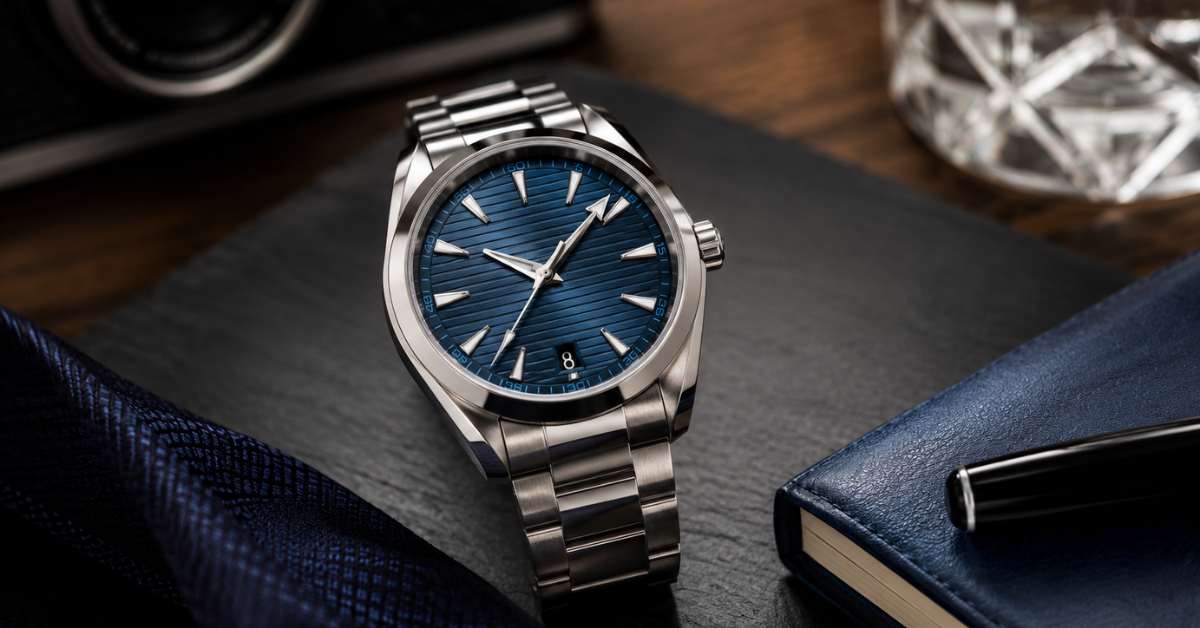
Within Omega's own catalog, the comparison that comes up most is De Ville versus Aqua Terra. They serve different purposes, honestly. The De Ville is a dedicated dress watch — thinner case, more formal dial, 30m water resistance. The Aqua Terra is a dressy sports watch that can actually handle 150m of water resistance and a more casual wardrobe. If you only want to own one watch, the Aqua Terra is the safer, more flexible pick. If you already have a sports watch and want something purpose-built for formal wear, the De Ville is the better buy.
For a broader look at how Omega structures its whole lineup, our Omega watches buying guide walks through movements, collections, and pricing across the brand.
FAQ
Is the Omega De Ville a good investment? Not really, and no dress watch bought new should be treated as one. Resale on De Ville references tends to track close to or slightly above the brand average, which is decent for a dress watch, but it's not a Speedmaster Moonwatch. Buy it because you want to wear it.
What's the difference between De Ville Prestige and Trésor? The Prestige is Omega's mainstream dress watch, available in a wide range of sizes with the full Co-Axial Master Chronometer movement. The Trésor is thinner and more minimalist, aimed at buyers who want a dedicated dress piece rather than an everyday watch.
Is the Omega De Ville waterproof? It's rated to 30 meters, which covers splashes and light rain but not swimming or submersion. Take it off before you shower or swim.
Does the De Ville come with a Master Chronometer movement? Most current Prestige and higher-end Trésor references do, certified by METAS for magnetic resistance and accuracy. Some entry-level Trésor models still use quartz movements, so check the specific reference before buying.
How does the De Ville compare to the Aqua Terra? The De Ville is a dedicated dress watch with 30m water resistance and a thinner case. The Aqua Terra is more of a dressy sports watch with 150m water resistance, making it the more versatile daily option.
What size De Ville should I buy? For men, 39.5mm is the sweet spot for most wrists — enough presence without overwhelming a shirt cuff. The 41mm suits larger wrists or anyone who prefers a slightly bolder proportion. Smaller references, down to 34mm, are aimed at ladies' sizing.
Final Thoughts
The Omega De Ville doesn't need to be flashy to be good, and that's kind of the point of a dress watch in the first place. What you're paying for is a Co-Axial Master Chronometer movement in a case that disappears under a cuff — and at this price, that combination is hard to find anywhere else. If your wardrobe already has a sports watch covered, this is the one that fills the gap.
Reviews Editor
Sofia Marchetti
Sofia focuses on dive watches, chronographs and everyday wearability, testing every piece in real-world conditions before forming a verdict.