On this page
- The Most Famous Scale You've Probably Never Used
- What Is a Tachymeter?
- How to Use a Speedmaster Tachymeter: Step by Step
- A Worked Example
- The Simple Maths Behind It
- What If It Takes Longer Than 60 Seconds?
- Everyday Uses You Might Not Expect
- Measuring a Production Rate
- Running and Cycling
- On a Train or Plane
- Just for Fun
- Limitations to Know
- The Tachymeter as a Collector's Detail
- Which Speedmasters Have a Tachymeter?
- Tachymeter vs Other Bezel Scales
- Frequently Asked Questions
- How do you use a tachymeter on an Omega Speedmaster?
- What is the formula for a tachymeter?
- Does a tachymeter measure km/h or mph?
- Why does the Speedmaster tachymeter stop at 60?
- What is the highest reading on a Speedmaster tachymeter?
- Can a tachymeter measure distance?
- The Bottom Line
The Most Famous Scale You've Probably Never Used
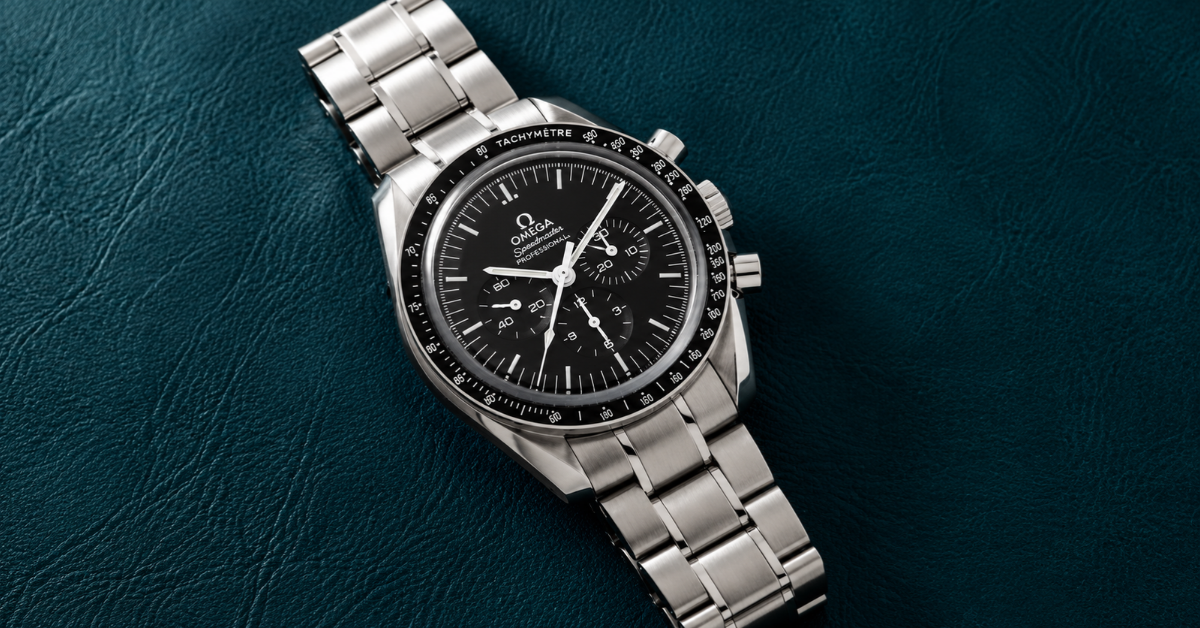
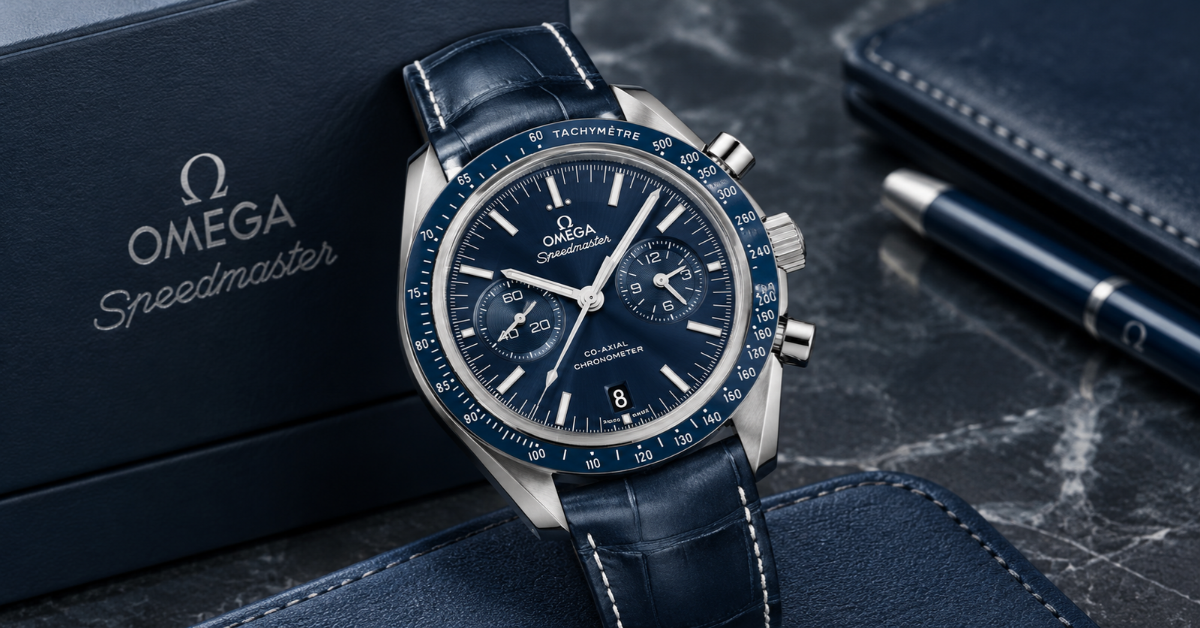
Look at any Omega Speedmaster and you'll see it: the word TACHYMETRE printed around the bezel, with numbers running from 500 down to 60. It's one of the most recognisable details in watchmaking.
Yet most owners have never actually used it. That's a shame, because once you understand it, it takes about ten seconds to learn and it's genuinely fun to use.
This guide explains what the tachymeter does, how to use it step by step, the maths behind it, some surprisingly practical everyday uses and its limitations. You'll never look at your Speedmaster's bezel the same way again.
What Is a Tachymeter?
A tachymeter is a scale that converts the time it takes to complete something into a rate per hour. On a watch, it's used with the chronograph (the stopwatch function) to calculate speed.
The idea is simple. If you know how long it takes to travel one unit of distance, you can work out how many of those units you'd cover in an hour. The tachymeter does that division for you, printed in a circle around the dial.
The Speedmaster was born as a racing chronograph in 1957, and it put the tachymeter on the bezel instead of the dial, giving the dial more room and making the scale easier to read. That's why it feels so natural on a Speedmaster: the tachymeter is part of its original purpose, before NASA and the Moon made it famous. For that side of the story, see the Speedmaster's Moon landing story.
How to Use a Speedmaster Tachymeter: Step by Step
You need a known distance, usually one kilometre or one mile. Highway markers, running tracks and measured routes all work well.
- Reset the chronograph. Make sure the central chronograph seconds hand is at 12 o'clock. If it isn't, press the lower pusher (at 4 o'clock) to reset it.
- Start the chronograph at the starting point. Press the upper pusher (at 2 o'clock) the moment you pass your starting marker.
- Stop it at the finish. Press the upper pusher again as you pass the marker exactly one kilometre or one mile later.
- Read the bezel. Look at where the chronograph seconds hand has stopped and read the number on the tachymeter scale next to it.
- That's your speed. If you measured over a kilometre, the number is in km/h. If you measured over a mile, it's in mph.
- Reset. Press the lower pusher to return the hand to zero.
Important: never press the reset pusher while the chronograph is running. Always stop it first. It's a good habit that protects the movement.
A Worked Example
You're a passenger in a car on a highway with kilometre markers.
- You start the chronograph as you pass the 10 km marker.
- You stop it as you pass the 11 km marker.
- The chronograph seconds hand stops at 40 seconds.
- On the bezel, 40 seconds lines up with 90.
So the car was averaging 90 km/h over that kilometre. If the markers had been miles, it would be 90 mph.
A few more reference points:
- 60 seconds reads 60 (the slowest speed the scale can show)
- 45 seconds reads 80
- 30 seconds reads 120
- 20 seconds reads 180
- 12 seconds reads 300
- 7.2 seconds reads 500 (the fastest speed on most Speedmaster bezels)
The Simple Maths Behind It
There's no magic. The tachymeter uses one formula:
Speed per hour = 3,600 ÷ seconds taken
There are 3,600 seconds in an hour. If one kilometre takes 40 seconds, then in an hour you'd cover 3,600 ÷ 40 = 90 kilometres. The bezel simply prints the answer for every second between 7.2 and 60.
Knowing the formula also helps you check readings and work out results the scale can't show.
What If It Takes Longer Than 60 Seconds?
The tachymeter scale only covers one minute. If your event takes longer, the scale can't show the answer directly. You have two options:
- Measure a shorter distance. Use half a kilometre instead, then double the reading.
- Use the formula. Divide 3,600 by the total number of seconds. For example, a kilometre taking 90 seconds means 3,600 ÷ 90 = 40 km/h.
The same trick works for anything faster than 7.2 seconds: measure a longer distance, such as two kilometres, then halve the reading.
Everyday Uses You Might Not Expect
The tachymeter isn't just for cars. Because it converts "time per unit" into "units per hour," it works for any repeating task.
Measuring a Production Rate
If a task takes 30 seconds, the bezel reads 120, meaning you could do it 120 times an hour. Workshops and factories have used this for decades.
Running and Cycling
Time yourself over a measured kilometre on a track or a marked path. A 45-second kilometre on a bike reads 80 km/h, which would be impressive. Most runners will fall outside the 60-second range, so use the formula instead: a 4-minute kilometre (240 seconds) is 3,600 ÷ 240 = 15 km/h.
On a Train or Plane
Trains often pass distance markers along the track. Timing the gap between them is a fun way to estimate speed on a journey.
Just for Fun
Honestly, that's how most owners use it. It's a small, satisfying bit of mechanical problem-solving that a phone can't replicate.
Limitations to Know
- You need a known distance. Without one kilometre or one mile marked out, the reading means nothing.
- It shows average speed. The result is your average across the measured distance, not your speed at any single moment.
- Precision is limited. Reading between the marks on the bezel is an estimate, especially at higher speeds where the numbers are closer together.
- Reaction time matters. Starting or stopping a fraction of a second late changes the result, especially for short, fast measurements.
- Never time yourself while driving. Use it as a passenger, or on a safe, controlled route.
The Tachymeter as a Collector's Detail
For Speedmaster collectors, the tachymeter bezel is about much more than speed. Small changes in its printing help identify different generations of the watch. The position of the dot next to the number 90, for example, is a detail collectors look for: the modern Moonwatch features the "dot over 90" that's associated with the Speedmasters of the Apollo era.
Because collectors care so much about the bezel, it's also one of the first places to check when you're buying. Misaligned numbers, poor printing and the wrong font are common signs of a replacement or fake bezel. Our guide on how to spot a fake Omega Speedmaster covers what to look for, and 3 questions to ask before buying a used Speedmaster covers the rest.
Which Speedmasters Have a Tachymeter?
Most Speedmasters do, including:
- Speedmaster Moonwatch Professional: the classic. See our Moonwatch price guide and Reverse Panda vs Classic.
- Speedmaster '57: a vintage-inspired version. Compare it in Speedmaster '57 vs Moonwatch.
- Speedmaster 38: a smaller automatic version with Moonwatch-style bezel typography. See how it compares with an old favourite in Speedmaster 38 vs Speedmaster Reduced.
For the full line-up, see the best Omega Speedmaster models. And if you're deciding between Omega's chronograph and dive families, our Speedmaster vs Seamaster comparison helps.
Tachymeter vs Other Bezel Scales
A tachymeter is often confused with other scales you'll see on watches:
- Tachymeter: measures speed over a known distance.
- Pulsometer: measures heart rate by counting a set number of beats.
- Telemeter: measures distance to an event using the speed of sound, such as lightning and thunder.
- Dive bezel: tracks elapsed time underwater, like on the Seamaster.
The Speedmaster's tachymeter is by far the most common, and the most useful in everyday life.
Frequently Asked Questions
How do you use a tachymeter on an Omega Speedmaster?
Start the chronograph as you pass a starting point, stop it after exactly one kilometre or one mile, and read the number on the bezel where the chronograph seconds hand stopped. That number is your average speed in km/h or mph.
What is the formula for a tachymeter?
Speed per hour equals 3,600 divided by the number of seconds taken to cover one unit of distance. For example, 40 seconds per kilometre equals 3,600 ÷ 40 = 90 km/h.
Does a tachymeter measure km/h or mph?
Both. The tachymeter works in whatever unit you measure. Time one kilometre and the result is in km/h; time one mile and the result is in mph.
Why does the Speedmaster tachymeter stop at 60?
The scale covers one minute of chronograph timing. An event taking 60 seconds per unit equals 60 units per hour, the lowest reading the scale can show. For longer events, divide 3,600 by the total seconds instead.
What is the highest reading on a Speedmaster tachymeter?
Most Speedmaster tachymeter bezels start at 500, which corresponds to covering one unit of distance in 7.2 seconds.
Can a tachymeter measure distance?
Indirectly. If you know your speed, you can work backwards, but a tachymeter is designed to measure speed over a known distance. A telemeter scale is the tool designed to measure distance.
The Bottom Line
The tachymeter is the part of the Speedmaster most people ignore, and one of the easiest to master. Start, stop, read: three steps, and you've turned your watch into a speedometer that's been doing the same job since 1957.
Next time you're a passenger on a highway, try it. You'll understand why the Speedmaster has felt like a proper instrument for nearly seventy years.
Editor-in-Chief
Editorial Team