On this page
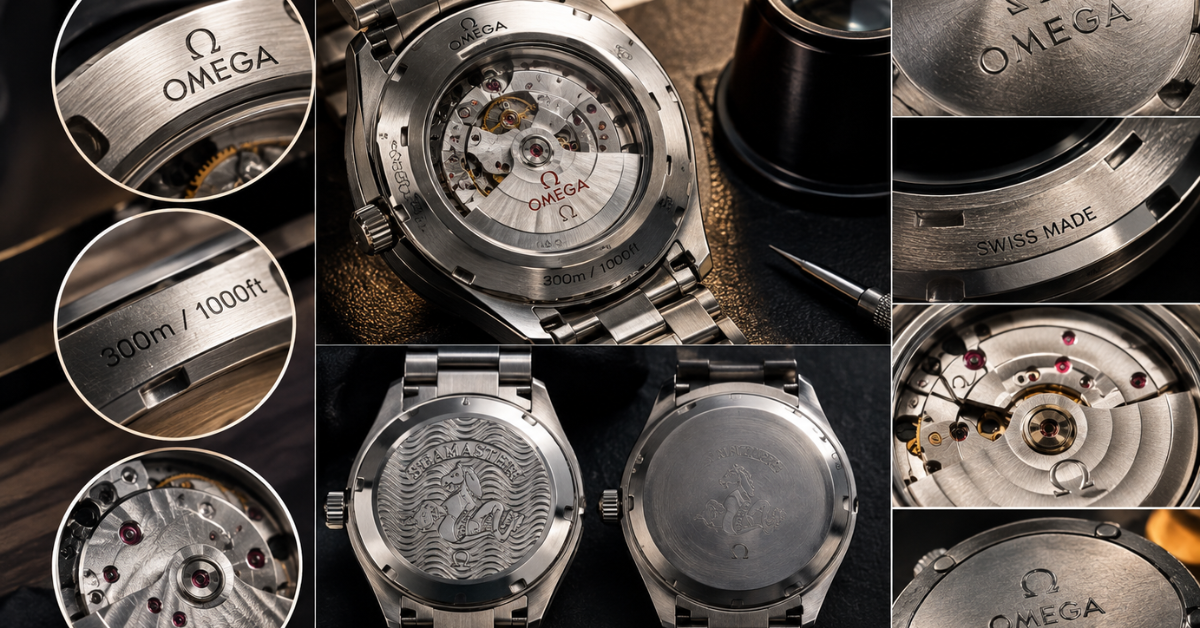
An Omega caseback reveals a fake in ways most buyers never think to check. Genuine casebacks thread on with tight, even resistance and sit perfectly flush against the case, while fakes often feel gritty or sit slightly crooked. Through a sapphire exhibition back, a genuine Co-Axial movement shows arabesque Côtes de Genève decoration on rhodium-plated bridges — fakes frequently run a generic decorated movement with the wrong escapement entirely. The strongest single check is a three-way match: the serial number engraved on the case should match the number on the movement and the figure printed on the warranty paperwork, a level of consistency counterfeiters rarely achieve across all three.
The caseback gets less attention than the dial in most fake-spotting advice, which is exactly why it's worth a closer look — it's harder to fake convincingly than a printed dial, and it carries several genuinely distinctive details most buyers never think to check. This covers five ways a fake caseback typically gives itself away, across Omega's catalog broadly rather than one specific model.
1. The Three-Way Serial Number Match
This is the single strongest check available, and it's worth understanding why. A genuine Omega's serial number should appear consistently across three separate places: engraved on the case (location varies by model and era — the caseback, the underside of a lug, or occasionally inside the case on vintage pieces), stamped or engraved on the movement itself, and printed on the accompanying warranty documentation. All three should show the identical number.
Counterfeiters can copy a plausible-looking serial number onto a caseback easily enough. What they rarely manage is making all three layers agree — the movement serial, the case serial, and the paperwork serial matching each other precisely. If you can check more than one of these, a mismatch anywhere is close to definitive proof of a problem. Our piece on verifying Omega's Master Chronometer certification covers Omega's own official online lookup tool, which ties a specific serial number to real, watch-specific test data — a useful extension of this same three-way matching principle for any Master Chronometer-certified piece.
2. Screw-Down Thread Quality
This is a tactile check, not just visual, and it's genuinely difficult for a cheap counterfeit to replicate well. On a genuine Omega, the caseback threads onto the case with tight, even resistance throughout the rotation, seating perfectly flush against the case with no visible gap or crookedness. Fakes frequently feel gritty or inconsistent as you thread them, or settle slightly off-center rather than sitting perfectly flush. This detail requires precise machining tolerances that add real manufacturing cost — exactly the kind of expense a counterfeit built to hit a low price point tends to cut.
3. Movement Decoration Through the Display Back
If the caseback is a sapphire exhibition window, this is where a fake often gives itself away most decisively. A genuine Omega Co-Axial movement shows specific, recognizable finishing — arabesque Côtes de Genève striping across rhodium-plated bridges, and a free-sprung silicon balance wheel visible in the escapement. Counterfeits frequently substitute an entirely different, generic decorated movement — sometimes a Miyota or Seagull base — dressed up to look vaguely similar from a glance but built around the wrong escapement architecture altogether. This isn't a subtle finishing difference; it's a fundamentally different movement wearing an Omega-branded exterior. Our general fake Omega guide covers additional movement-specific checks that pair well with this one.
4. Sapphire Crystal Clarity
On models with a display caseback, look closely at the crystal itself, not just what's visible through it. A genuine sapphire caseback crystal is perfectly clear, with no optical distortion, waviness, or tinting when you tilt it under light. Lower-grade substitute crystals used on counterfeits can show subtle imperfections here — a slight warp in how the movement looks through the glass at an angle, or an inconsistent tint compared to the crystal on the front of the watch. It's a small detail, but a real one worth checking specifically rather than assuming any clear-looking caseback crystal is equally well made.
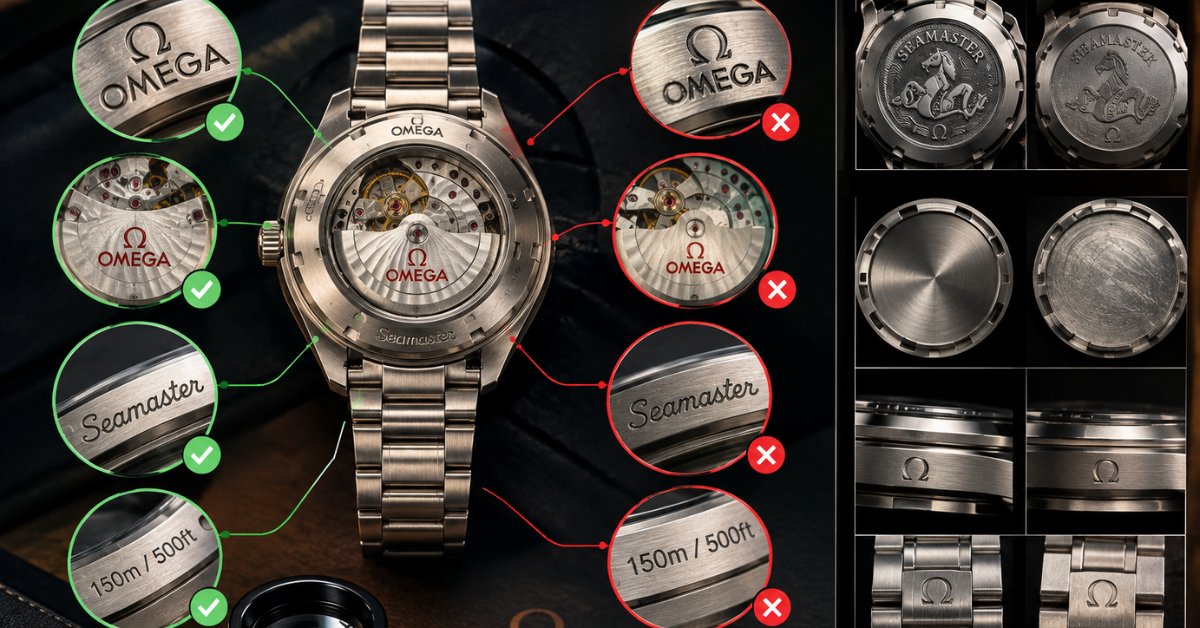
5. Model-Specific Engraving Sharpness
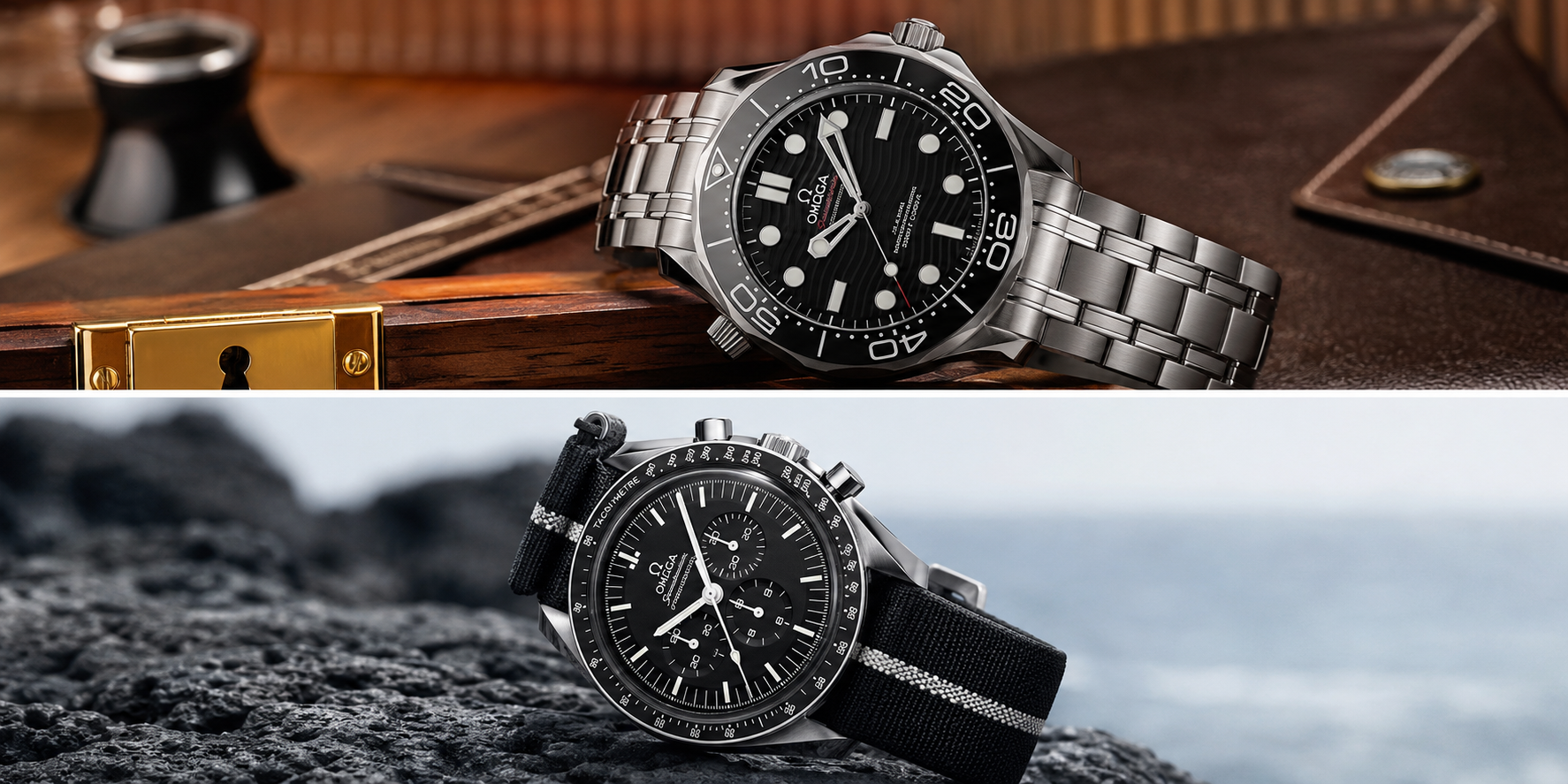
Depending on the collection, genuine Omega casebacks carry model-specific engraved details — the Seahorse medallion on Seamaster references, specific embossed detailing on Speedmaster casebacks, and similar model-appropriate markings elsewhere in the catalog. On a genuine watch, these engravings are sharply defined with consistent depth throughout. Fakes typically show shallow, blurry, or inconsistent engraving depth on these same details — noticeable once you know to look closely rather than accepting the general shape as sufficient. Our Seamaster bezel click test and Speedmaster-specific authentication checks both cover model-specific caseback and case details in more depth if you're evaluating one of those two collections specifically.
Worth checking alongside this: clasps, crowns, and buckles are typically signed on a genuine Omega, with sharp, well-defined engraving. Unsigned components, or ones with noticeably crude finishing, are worth treating as a related red flag — though it's fair to note some vintage or military-issued references are legitimate exceptions to this pattern, so context matters.
What These Checks Won't Guarantee
As with any authentication approach, it's worth being honest about the limits. The highest-quality counterfeits have gotten close enough on individual caseback details that no single check, or even all five together, provides absolute certainty on its own. These checks catch the significant majority of fakes in circulation, particularly since replicating precise thread tolerances and genuine Co-Axial movement decoration is genuinely expensive to do well. For any high-value purchase, professional authentication from an authorized Omega service center or an experienced independent watchmaker remains the only way to be fully certain.
FAQ
What's the single best caseback check for a fake Omega? The three-way serial number match — confirming the case, movement, and warranty paperwork all show the identical serial number — since counterfeiters rarely manage to make all three agree consistently.
Do all genuine Omega watches have the serial number in the same place? No — placement varies by model and production era, appearing on the movement, the caseback, or the underside of a lug depending on the specific watch, so its absence in one location doesn't automatically indicate a fake.
Can a fake Omega have a real-looking movement through the display back? It can look superficially similar, but genuine Omega Co-Axial movements show specific decoration — arabesque Côtes de Genève on rhodium-plated bridges and a free-sprung silicon balance — that generic substitute movements used in fakes typically can't replicate accurately.
Why does the caseback thread quality matter for authentication? Genuine Omega casebacks thread on with tight, even resistance and sit perfectly flush, a precision that requires manufacturing tolerances counterfeiters built to a low price point often skip.
Is engraving depth a reliable way to spot a fake Omega caseback? Yes — genuine model-specific engravings, like the Seamaster's Seahorse medallion, show sharp, consistent depth, while fakes commonly show shallow or blurry detailing on the same markings.
Conclusion
The caseback rewards close attention precisely because it's harder to fake convincingly than a printed dial — genuine thread precision, movement decoration, and engraving depth all require manufacturing investment that counterfeits built to a price point consistently skip. Run the three-way serial match alongside the other four checks here, and you'll catch the overwhelming majority of fakes before you ever need a professional opinion.
Senior Watch Writer
James Whitfield
James has spent over a decade covering Swiss horology, vintage markets and modern releases. He believes the best watch is the one you actually wear.