On this page
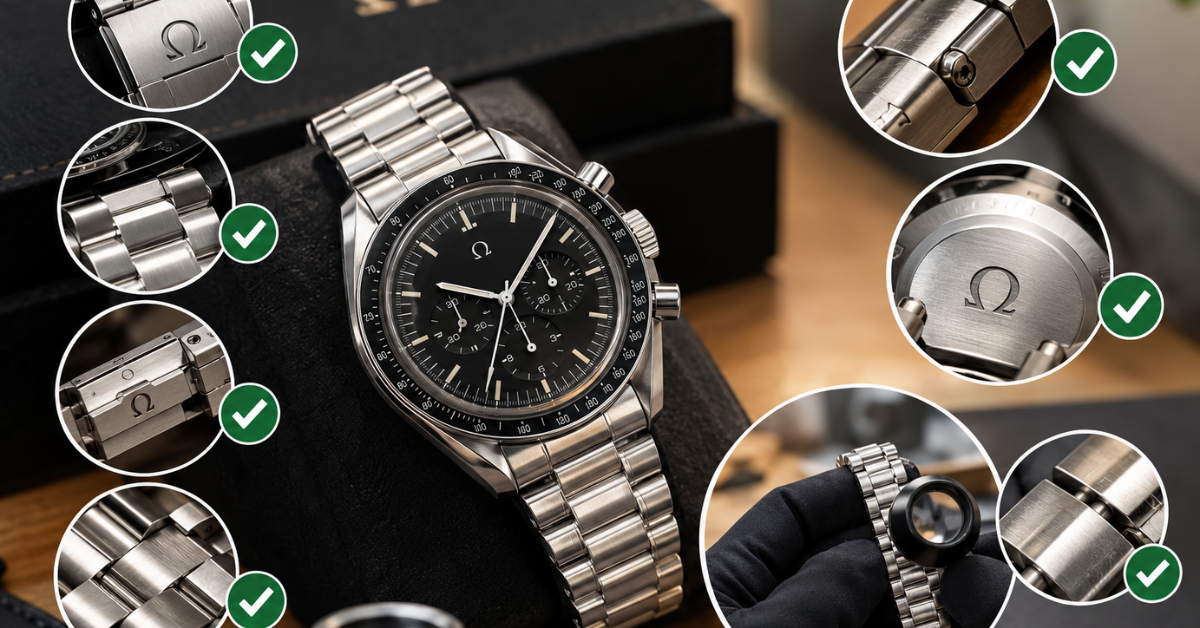
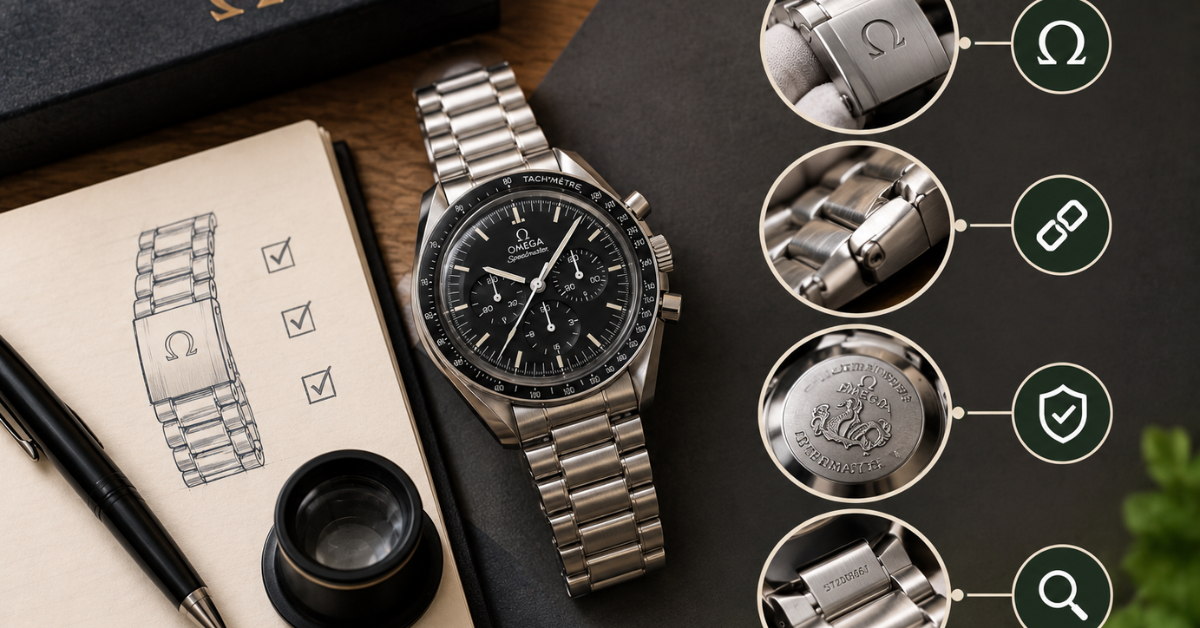
A genuine Omega bracelet reveals itself in details counterfeiters consistently rush past: deep, crisp engraving on the end links where the bracelet meets the case, an "OMEGA" inscription and correct model-specific stamping inside the clasp, brushed link sides matching the case's finishing rather than polished, center links that taper cleanly and articulate smoothly without looseness, and — on modern dive watches — a functioning micro-adjustment system activated by a discreet "PUSH" engraving. Our caseback-specific authentication guide covers the other side of the watch; this piece focuses entirely on the bracelet itself.
Bracelets get less scrutiny than dials and casebacks in most fake-spotting advice, which is exactly why they're worth a closer look — genuine bracelet construction involves precision tolerances that are expensive to replicate cheaply, and several details here are genuinely difficult for counterfeiters to get right even on otherwise convincing fakes.
1. End-Link Engraving Depth
This is one of the more reliable checks available, and it's specific enough that a documented forum case flagged it as the single detail exposing an otherwise near-perfect counterfeit. The end links — where the bracelet's first links meet the case — carry engraved striping or detailing that should be deep and crisply defined on a genuine Omega. On the fake in question, everything else checked out convincingly except this one detail: the engraved stripes on the end link were noticeably shallower than on a verified genuine example. Compare the end-link engraving closely against verified reference photos of the same model; shallow or poorly defined detailing here is a legitimate concern even when the rest of the watch looks right.
2. Clasp Engraving and Model-Specific Stamping
Open the clasp and look closely at what's actually engraved inside. Genuine Omega clasps carry an "OMEGA" inscription, typically positioned beneath the crown logo, with sharp, well-defined engraving throughout. Depending on the specific bracelet type, there's often additional model-specific stamping as well — certain vintage bracelet styles, for instance, carry a specific reference number stamp that counterfeits frequently omit entirely or get wrong. A missing "OMEGA" text under the logo, or absent model-specific stamping where a genuine example would have it, is worth treating as a real red flag rather than a minor omission.
Worth a small caveat here: because this engraving is extremely small, its orientation isn't always perfectly aligned even on genuine watches, so a slightly crooked logo alone isn't automatically disqualifying — it's the presence, depth, and correct wording of the engraving that matters most, not perfect symmetry.
3. Finishing Consistency: Brushed vs. Polished
Genuine Omega bracelets match their finishing language to the case — link sides are typically brushed to correspond with the case's own brushed surfaces, with polished elements reserved for specific flanks or edges depending on the model. A documented case involving a Seamaster bracelet flagged polished link sides where brushed finishing was expected as one of the details raising suspicion. If the bracelet's overall finish doesn't match what you'd expect for that specific reference — polished where it should be brushed, or an inconsistent mix that doesn't correspond to the case's own finishing pattern — that mismatch is worth investigating further.
4. Center Link Width and Articulation
Run your fingers along the bracelet and pay attention to both proportion and movement. Genuine Omega bracelets typically feature center links that are slightly wider than the outer links, tapering cleanly and smoothly into the clasp. Counterfeits frequently narrow the center link relative to genuine proportions, and the overall articulation often feels different in the hand — loose, stiff, or uneven as the bracelet moves, rather than the smooth, consistent flex a genuine bracelet's precisely toleranced links provide. This is a tactile check as much as a visual one; a bracelet that doesn't move naturally across your wrist is telling you something even before you look closely at individual links.
5. The PUSH Micro-Adjustment System
On modern Omega dive watches specifically — the Seamaster Diver 300M and similar current references — a genuine clasp includes a micro-adjustable extension system, activated by a discreet "PUSH" engraving inside the clasp, allowing tool-free bracelet resizing. This feature exists specifically for practical reasons, letting a diver adjust fit over a wetsuit without needing tools, and its presence and correct execution is considered essentially non-negotiable on genuine current dive references. Counterfeits frequently skip this mechanism entirely, or include a poorly replicated version with the "PUSH" text engraved crudely or in an incorrect font. If a modern Seamaster's clasp shows no sign of this adjustment system at all, that's one of the more decisive checks available for this specific category of watch. Our Seamaster bezel click test covers additional Seamaster-specific authentication details worth checking alongside this one.
Weight and Overall Feel
Beyond the five specific checks above, genuine Omega bracelets contribute real, noticeable weight to the overall watch — hollow, stamped links used in cheaper fakes feel noticeably lighter and can sound tinny when tapped gently, compared to the dense, solid feel of genuine construction. This ties directly into the broader weight checks covered in our general fake Omega guide — the bracelet is a meaningful part of that overall heft, not just the case.
What These Checks Won't Guarantee
As with any authentication approach, it's worth being honest about the limits. The best counterfeits have gotten close enough on individual bracelet details that no single check, or even all five together, provides absolute certainty on its own. These checks catch the significant majority of fake or mismatched bracelets in circulation — including the specific scenario where a genuine watch head has been paired with a counterfeit or aftermarket bracelet, which happens more often in the pre-owned market than buyers expect. For any high-value purchase, professional authentication from an authorized dealer or an experienced independent watchmaker remains the most reliable way to be certain.
FAQ
Can a genuine Omega watch have a fake bracelet? Yes — this happens more often than buyers expect in the pre-owned market, where a genuine watch head gets paired with a counterfeit or incorrect aftermarket bracelet, which is exactly why checking the bracelet separately from the case matters.
What's the fastest way to check an Omega bracelet's authenticity? Open the clasp and check for a clearly engraved "OMEGA" inscription beneath the crown logo, along with correct model-specific stamping — missing or shallow engraving here is one of the more reliable red flags.
Do all genuine Omega dive watches have a PUSH button in the clasp? Current-generation dive references like the Seamaster Diver 300M do, as a functional micro-adjustment system for tool-free resizing — its absence on a watch that should have it is a strong warning sign.
Should a genuine Omega bracelet feel loose when I move it? No — genuine bracelets articulate smoothly and consistently; looseness, stiffness, or uneven movement in the links often indicates incorrect construction or a counterfeit.
Is a slightly crooked clasp logo proof of a fake? Not on its own — the engraving is small enough that minor alignment variation can occur even on genuine watches; the engraving's depth, correct wording, and overall sharpness matter more than perfect symmetry.
Conclusion
A watch's bracelet gets far less scrutiny than its dial or caseback in most authentication checklists, which makes it exactly the kind of detail worth checking carefully rather than assuming matches the rest of a convincing watch. End-link engraving, clasp stamping, finishing consistency, link taper, and the PUSH mechanism on modern dive references together catch the overwhelming majority of bracelet-specific problems — including watches that are otherwise entirely genuine but paired with the wrong bracelet somewhere along the way.
Senior Watch Writer
James Whitfield
James has spent over a decade covering Swiss horology, vintage markets and modern releases. He believes the best watch is the one you actually wear.