On this page
The Omega Ploprof earns its unconventional, blocky look through genuine engineering necessity, not a design misstep. Its name comes from "Plongeur Professionnel"—French for "professional diver"—and its single-piece monobloc case, developed with the French diving company COMEX in the late 1960s, is hermetically sealed enough that it never needed a helium escape valve at all, unlike most saturation-dive watches. Original vintage examples were discontinued and now carry genuine collector scarcity, while the modern 1200M reissue adds titanium and gold construction alongside Omega's Co-Axial movement technology. Current pricing spans roughly $7,000 to $18,000 depending on materials and rarity.
The Ploprof looks like nothing else in Omega's catalog, and that's not an accident of taste—it's the direct result of solving a genuinely difficult engineering problem in the most uncompromising way available. This covers why it looks the way it does and why that unconventional design commands the price it does.
What "Ploprof" Actually Means
The name is French shorthand, not a stylistic flourish: "Plongeur Professionnel," meaning "professional diver." Omega developed it in the late 1960s, specifically working with COMEX, a French company specializing in professional and saturation diving, as part of a genuine research project rather than a consumer product designed first and marketed second. Two internal prototypes, coded "Ploprof 0" and "Ploprof 1," followed the same core requirements; the Ploprof 1 prototype became the commercial Seamaster 600 Plongeur Professionnel, which debuted in 1971 and 1972.
This wasn't a watch that merely claimed professional-diver credentials—it was tested directly by COMEX divers and by teams working with Jacques Cousteau, the kind of documented field use that most "tool watch" marketing only gestures toward.
The Engineering Behind the "Ugly"
This is the part worth understanding properly, because every strange-looking detail on the Ploprof exists for a specific mechanical reason, not as an aesthetic choice.
The monobloc case is machined from a single piece of steel — using a custom internal alloy collectors have nicknamed "Uranus steel" — rather than assembled from separate case, back, and bezel components the way most watches are built. That single-piece construction makes the case hermetically sealed to a degree that solves the saturation-diving helium problem in a fundamentally different way than Rolex's approach with the Sea-Dweller. Rather than adding a valve to vent helium that's already entered the case, the Ploprof's sealed monobloc construction prevents helium from entering the case at all — no valve needed, because there's nothing to vent.
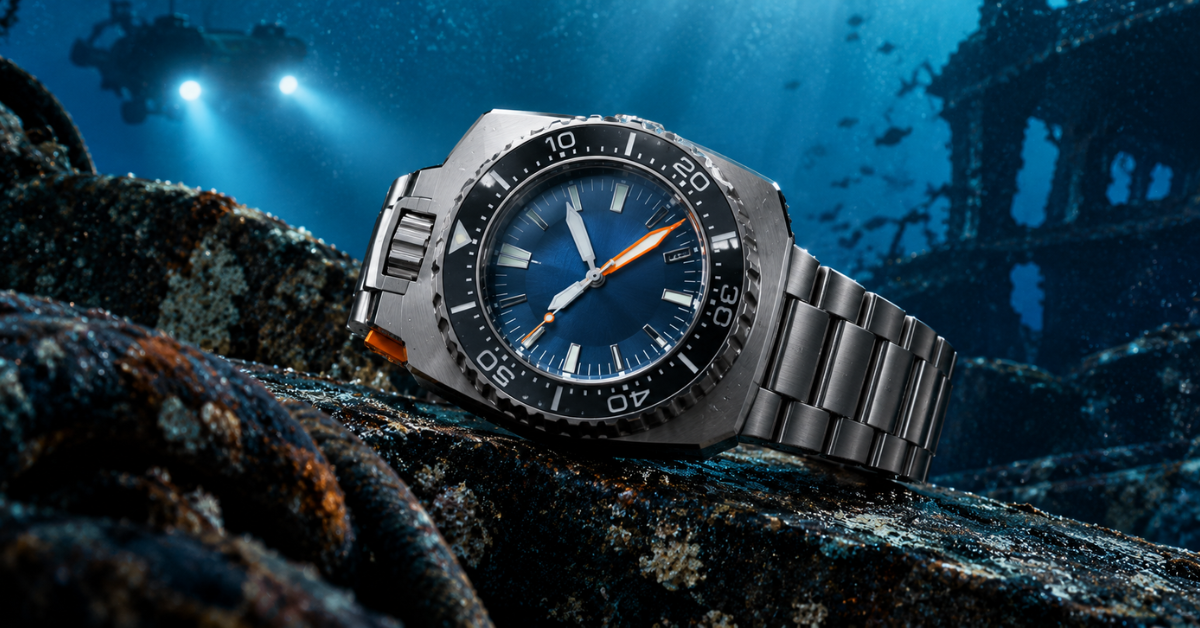
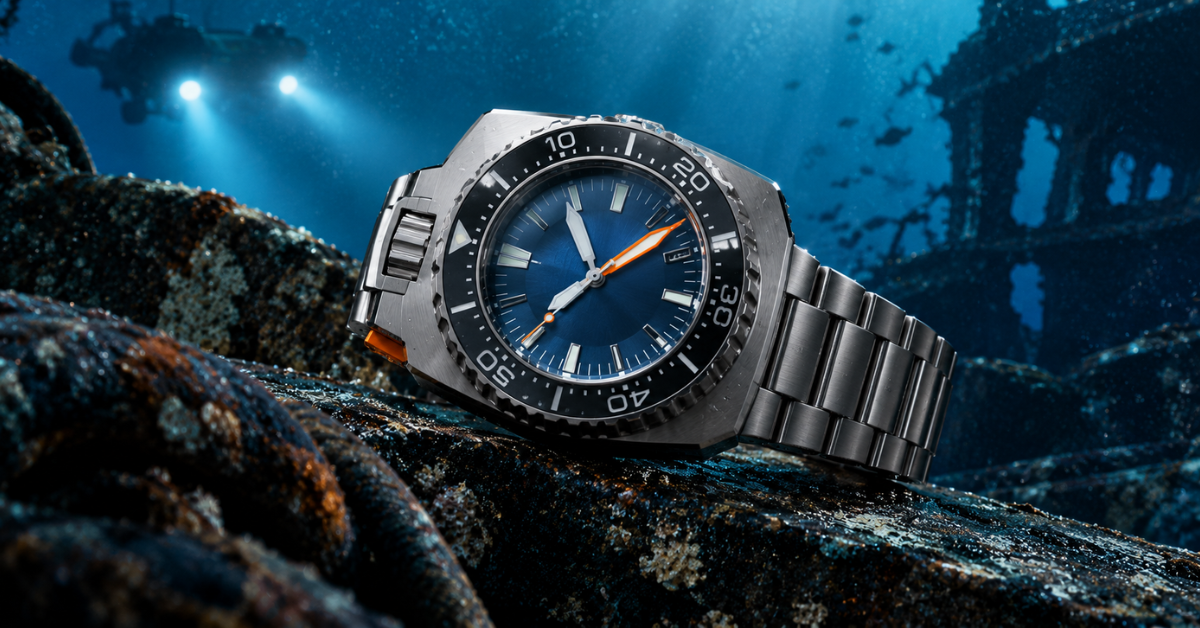
The left-side crown, an unusual placement by any watch's standards, exists for two specific reasons: it keeps the wrist's natural movement unobstructed on a case this large, and it frees up space on the case's right side for Omega's distinctive pusher mechanism — a locking system that prevents the bidirectional bezel from rotating accidentally, protected by its own dedicated crown guard.
The asymmetrical, squared-off case shape distributes water pressure evenly across the case structure, a genuine functional requirement at the depths this watch was built to survive, not a stylistic departure from conventional round dive-watch cases.
None of this reads as conventionally attractive next to a Seamaster Diver 300M's polished curves, and it was never trying to. Our Seamaster complete history covers where the Ploprof fits into the broader Seamaster family's evolution, alongside the more conventionally styled divers it shares a lineage with.
Original Specs and What Changed
The original 1970s Ploprof measured 55mm by 13.5mm, officially rated to 600 meters of water resistance but actually tested to 1,300 meters — more than double its stated rating, a genuine safety margin rather than a marketing figure. Omega eventually discontinued the original Seamaster 600, meaning any genuine vintage example today only exists on the pre-owned and collector market.
In 2009, Omega revived the design as the Seamaster Ploprof 1200M — same 55mm footprint, but rated to a genuinely doubled 1,200 meters and 120 bar of pressure, thanks to modern materials and construction techniques. The current lineup runs Omega's Co-Axial movement technology rather than the original's Caliber 1002, and it's available in titanium, stainless steel, and gold or rose gold configurations, with swappable strap and bracelet options that didn't exist on the solid-steel, rubber-strap-only original. A 2023 75th Seamaster anniversary edition added a gradient blue "Summer Blue" dial to the current generation, alongside a refreshed case design.
Titanium construction specifically matters here in a way it might not on a smaller watch: reviewers consistently note that despite the case's genuinely massive 55mm footprint, the titanium version feels surprisingly light on the wrist — a real practical benefit given how much watch you're actually wearing. For comparison against Omega's more conventionally proportioned dive watches, our Planet Ocean review and Seamaster Diver 300M review cover Omega's other current approaches to serious dive capability, both considerably more conventional in silhouette than the Ploprof.
So, Why Does It Cost So Much?
Current pricing spans roughly $7,000 to $18,000 depending on case material, condition, and rarity, with the most sought-after modern reference — the 227.90 — typically trading around $10,000 on the secondary market. Vintage originals in good condition generally command a similar range, and documented pieces with verifiable COMEX provenance — original field documentation, diver notes, confirmed early prototype status — can reach considerably higher, occasionally described by specialists as approaching museum-grade rarity.
That pricing reflects several genuine factors stacking together, not just brand markup on an unusual shape. The original's discontinuation created real collector scarcity for vintage examples. The monobloc construction and custom steel alloy represent manufacturing complexity most watches simply don't require. The documented COMEX and Cousteau-era field history gives it authentic tool-watch credibility that's difficult for any brand to manufacture after the fact. And the modern 1200M's titanium and gold configurations, combined with current Co-Axial movement technology, place it in genuinely premium materials territory regardless of how the case looks to someone unfamiliar with why it's shaped that way.
Who Should Actually Buy One
The Ploprof isn't for a buyer who wants a watch to blend in, and it was never designed to be. It suits someone who specifically values engineering-first design — a watch built to solve a real problem in the most direct way available, aesthetics treated as a distant second priority — and who wants something genuinely uncommon rather than another conventionally handsome dive watch. If that's not the appeal you're looking for, Omega's more mainstream divers will likely serve you better; our Omega Watches Buying Guide covers how to navigate the full catalog if the Ploprof's specific character isn't quite the fit.
Buying With Confidence
Given the genuine collector premiums involved, particularly on vintage examples with claimed provenance, buying from an authorized source or a verified, reputable dealer matters more than usual here. Our guide on how to spot a fake Omega watch covers the authentication fundamentals worth applying before any high-value purchase.
FAQ
What does "Ploprof" actually mean? It's short for "Plongeur Professionnel," French for "professional diver" — the watch was developed with the French diving company COMEX specifically for saturation diving research.
Why doesn't the Ploprof have a helium escape valve? Its monobloc, single-piece case construction is sealed tightly enough that helium can't enter the case in the first place during saturation diving, eliminating the need for a valve entirely — a different engineering solution than the valve-based approach used by most saturation-dive watches.
Is the original Omega Ploprof still in production? No — the original Seamaster 600 has been discontinued, so genuine vintage examples are only available on the pre-owned and collector market; Omega currently produces the modern Seamaster Ploprof 1200M instead.
How much does an Omega Ploprof cost? Generally $7,000 to $18,000 depending on materials, condition, and rarity, with the most in-demand modern reference typically trading around $10,000 on the secondary market.
What's the water resistance difference between the original and modern Ploprof? The original was rated to 600 meters (tested to 1,300m); the modern 1200M reissue, introduced in 2009, doubles that official rating to 1,200 meters using contemporary materials and construction.
Conclusion
The Ploprof's price and its unconventional looks come from the same source: a genuine, uncompromising engineering solution to saturation diving's hardest problems, built by a company that tested it with the actual divers who needed it to work. It was never designed to be conventionally handsome, and that's precisely the point — every strange angle and oddly placed crown exists because it had to, not because Omega thought it looked good. That's a rarer, more expensive kind of design integrity than most watches ever attempt.
Senior Watch Writer
James Whitfield
James has spent over a decade covering Swiss horology, vintage markets and modern releases. He believes the best watch is the one you actually wear.