On this page
- Why Dating Your Omega Matters
- Step 1: Find Your Omega's Serial Number
- Vintage Omegas (Before the Late 1980s)
- Modern Omegas
- Don't Confuse It With the Reference Number
- Step 2: Check the Omega Serial Number Chart
- Early Omega: 1894 to 1944
- Post-War and Golden Era: 1947 to 1969
- The 1970s and 1980s
- Late 1980s to the 2000s
- Step 3: Dating a Modern Omega
- The Most Accurate Option: Omega's Extract From the Archives
- Special Case: Dating a Vintage Speedmaster
- Can a Serial Number Prove an Omega Is Real?
- What Your Omega's Age Means for Its Value
- Frequently Asked Questions
- Where is the serial number on an Omega watch?
- How do I find out what year my Omega was made?
- Is there an official Omega serial number lookup?
- What is an Omega Extract from the Archives?
- Does the number on the Speedmaster caseback show the year?
- Can a fake Omega have a real serial number?
- The Bottom Line
Why Dating Your Omega Matters
Maybe you've inherited a watch from a grandparent. Maybe you've found a vintage Seamaster at a market, or you're about to buy a pre-owned Speedmaster. Whatever brought you here, knowing your Omega's age helps you:
- Understand its value. Age, combined with condition, originality and model, has a big effect on price.
- Check that everything matches. The movement, dial, hands and case should all belong to the same era. A mismatch can mean replaced parts or worse.
- Plan servicing. Older watches usually need more care.
- Learn its story. For a family watch, the year is often the most meaningful detail of all.
Omega has one of the best-documented archives in watchmaking, which makes its watches easier to date than many brands. But there's no official public serial lookup, and online charts disagree slightly in places. Treat any date from a chart as a close estimate.
Step 1: Find Your Omega's Serial Number
Where you'll find the serial depends on the age of the watch.
Vintage Omegas (Before the Late 1980s)
On older Omegas, the important serial number is on the movement, usually a seven- or eight-digit number. To see it, the caseback has to come off. Don't try this yourself unless you have the right tools; a slip can scratch the case or damage the movement. A watchmaker can open it in a few minutes.
Inside the caseback, you'll usually also find a reference number (the model) and sometimes a separate case serial. Until 1986, Omega numbered movements and cases in two completely separate systems, so the case number won't match the movement number. The movement serial is the one used for dating.
Modern Omegas
On more recent Omegas, the serial number is engraved on the outside of the case, typically on the back of a lug or on the caseback. Many modern Omegas have a sapphire display back, so you can see the movement without opening the watch.
Don't Confuse It With the Reference Number
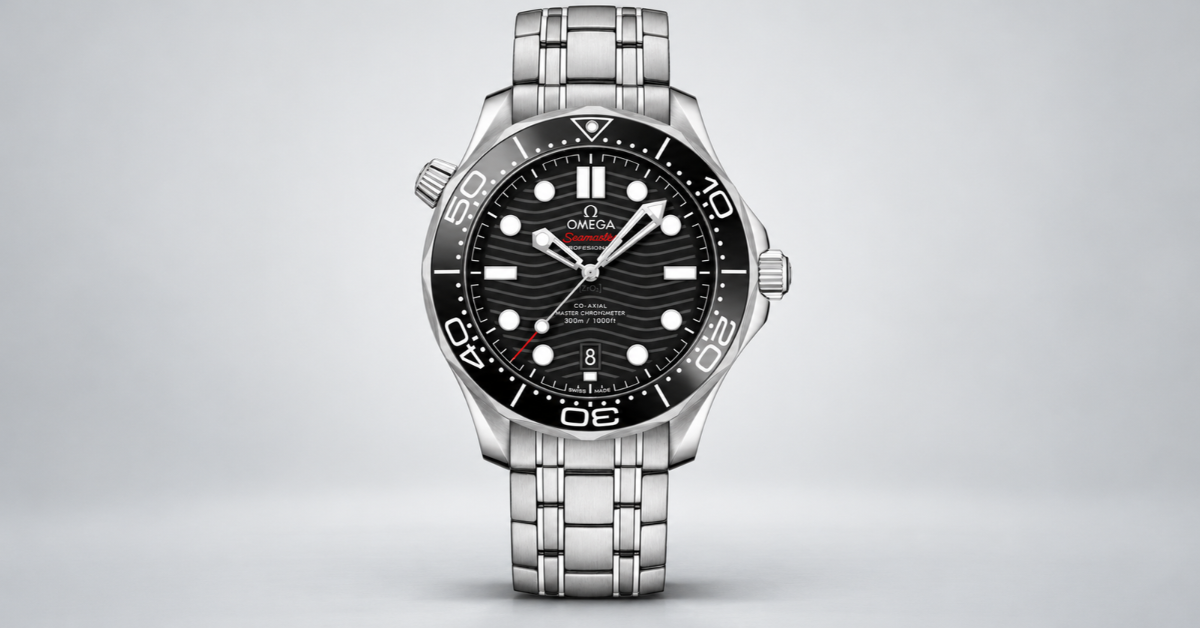
The reference number identifies the model, not the individual watch. On a modern Diver 300M, for example, it looks like 210.30.42.20.01.001. On vintage Omegas, references like "ST 145.022" or "CK 2998" appear inside the caseback. These help you identify the model, but they don't give you the production year on their own.
Step 2: Check the Omega Serial Number Chart
Find the number just below or equal to your movement serial. That's the approximate year production began for that range.
Early Omega: 1894 to 1944
- 1,000,000: about 1894–1895
- 2,000,000: about 1902
- 3,000,000: about 1906–1908
- 4,000,000: about 1910–1912
- 5,000,000: about 1915–1916
- 6,000,000: about 1923
- 7,000,000: about 1929
- 8,000,000: about 1934–1935
- 9,000,000: about 1939
- 10,000,000: about 1944
Early records are the least precise. Some charts show overlapping or out-of-order dates in this period, because Omega assigned blocks of numbers that weren't always used in strict sequence. Allow a few years either way.
Post-War and Golden Era: 1947 to 1969
- 11,000,000: about 1947
- 12,000,000: about 1950
- 13,000,000: about 1952
- 14,000,000: about 1954
- 15,000,000: about 1956
- 16,000,000: about 1958
- 17,000,000: about 1959–1960
- 18,000,000: about 1961
- 19,000,000: about 1962
- 20,000,000: about 1963
- 21,000,000: about 1964
- 22,000,000: about 1965
- 23,000,000 to 24,000,000: about 1966
- 25,000,000: about 1967
- 26,000,000 to 27,000,000: about 1968
- 28,000,000 to 31,000,000: about 1969
This is the era collectors love most, covering the classic Constellations, early Seamasters and the Speedmasters of the Moon landing years. For our favourite pieces from this period, see 5 best vintage Omega watches worth collecting.
The 1970s and 1980s
- 32,000,000: about 1970
- 33,000,000: about 1971
- 34,000,000 to 35,000,000: about 1972
- 36,000,000 to 37,000,000: about 1973
- 38,000,000: about 1974
- 39,000,000: about 1975
- 40,000,000: about 1977
- 41,000,000: about 1978
- 42,000,000 to 43,000,000: about 1979
- 44,000,000: about 1980
- 45,000,000: about 1982
- 46,000,000 to 47,000,000: about 1984
- 48,000,000: about 1985
- 49,000,000 to 50,000,000: about 1986
Late 1980s to the 2000s
- 51,000,000: about 1989
- 53,000,000: about 1991
- 54,000,000: about 1993
- 55,000,000: about 1995
- 56,000,000: about 1998
- Roughly 67,000,000 to 83,000,000: about 2005–2009
From the late 1980s onward, published charts become less consistent, and some number blocks were skipped. Use these ranges as a rough guide, then confirm with the warranty card or service papers.
Step 3: Dating a Modern Omega
For an Omega made in roughly the last 15 years, the serial number isn't a reliable dating tool on its own. Instead, use:
- The warranty card. It shows when the watch was sold by an authorised retailer, usually close to its production date.
- The reference number. Each modern reference has known launch and discontinuation years, which narrows the window.
- Master Chronometer test results. Omegas certified as Master Chronometers (introduced in 2015) can be checked online using Omega's own test-result lookup, which also helps confirm the watch is genuine. Here's how to verify a Master Chronometer Omega.
- Service records. A receipt from an Omega service centre confirms the watch existed by that date.
The Most Accurate Option: Omega's Extract From the Archives
If you want an official answer, Omega offers an Extract from the Archives, a certificate from its heritage department confirming details such as the production date, the original model and the country it was first delivered to.
It's especially worth getting for:
- Valuable vintage pieces, such as early Speedmasters or rare Seamasters
- Family watches with sentimental value
- Watches you plan to sell, since an extract adds credibility and often value
There's a fee, and you'll need clear photos of the movement and caseback, plus the serial and reference numbers. Requests can be made through Omega's website or an Omega boutique.
Special Case: Dating a Vintage Speedmaster
Speedmasters deserve their own note, because collectors scrutinise them more than almost any other Omega.
- The caseback reference suffix isn't the production year. On references like "ST 105.012-66" or "ST 145.022-69", the "-66" or "-69" refers to the case design version, not necessarily the year the watch was made. Always date a Speedmaster by its movement serial.
- The movement calibre matters. Earlier Speedmasters use the calibre 321, while later ones moved to the calibre 861 around 1968. A mismatch between calibre and claimed year is a red flag.
- Check the details. Dial, hands, bezel and pushers should all fit the era.
Before you buy a vintage Speedmaster, read 3 questions to ask before buying a used Omega Speedmaster and 9 reliable checks to spot a fake Speedmaster. For the story behind why these watches matter, see why the Omega Moonwatch actually went to the Moon.
Can a Serial Number Prove an Omega Is Real?
No. A serial number that fits a chart only proves the number is plausible. Counterfeiters often copy real serials, and "frankenwatches" can combine a genuine movement with a fake or mismatched case.
What matters is that everything lines up: the serial on the movement, the reference inside the caseback and the paperwork should all point to the same model and era. Our guide to how fake Omega casebacks give themselves away explains the three-way serial match, and 9 authentication checks for spotting a fake Omega covers the rest.
What Your Omega's Age Means for Its Value
Age alone doesn't make an Omega valuable. Originality, condition, rarity and the model matter more. A well-kept 1960s Constellation with its original dial can be worth more than a much newer watch in poor condition, while some vintage Speedmaster and Seamaster references have become serious collector pieces.
Modern Omegas follow a different pattern, usually selling below retail on the pre-owned market. Our analysis of Omega vs Rolex value retention explains why.
If your Omega is older and hasn't been serviced in a while, it's worth getting it checked. Here's how long an Omega watch really lasts, and what keeps it running for decades. If you're curious about the family history of the model you own, our complete Seamaster history is a good place to start.
Frequently Asked Questions
Where is the serial number on an Omega watch?
On vintage Omegas, the serial number used for dating is engraved on the movement, so the caseback has to be removed to see it. On modern Omegas, the serial is usually engraved on the outside of the case, often on the back of a lug or on the caseback.
How do I find out what year my Omega was made?
Find the movement serial number and compare it with an Omega serial number chart. For example, around 20,000,000 points to about 1963 and around 40,000,000 to about 1977. For modern Omegas, use the warranty card, reference number or service records instead.
Is there an official Omega serial number lookup?
Omega doesn't offer a free public serial lookup. Online charts are compiled from Omega's historical records but are approximate. For an official answer, you can order an Extract from the Archives from Omega for a fee.
What is an Omega Extract from the Archives?
It's an official certificate from Omega's heritage department confirming details about your watch, such as its production date, original model and the country it was first delivered to. It's useful for valuable vintage pieces and for proving a watch's history when selling.
Does the number on the Speedmaster caseback show the year?
No. The suffix in references like ST 105.012-66 refers to the case design version, not the production year. Date a vintage Speedmaster by its movement serial number instead.
Can a fake Omega have a real serial number?
Yes. Counterfeiters often copy genuine serial numbers. A serial that fits the chart doesn't prove authenticity, so check that the movement, caseback reference and papers all match.
The Bottom Line
For most vintage Omegas, the movement serial will get you within a year or two of when your watch was made. For modern pieces, the warranty card and reference number tell the story. And if you want the official answer, Omega's own archives can give it to you.
Either way, the year is just the start. When the serial, the reference, the dial and the papers all agree, you don't just know how old your Omega is. You know it's the real thing.
Senior Watch Writer
James Whitfield
James has spent over a decade covering Swiss horology, vintage markets and modern releases. He believes the best watch is the one you actually wear.