On this page
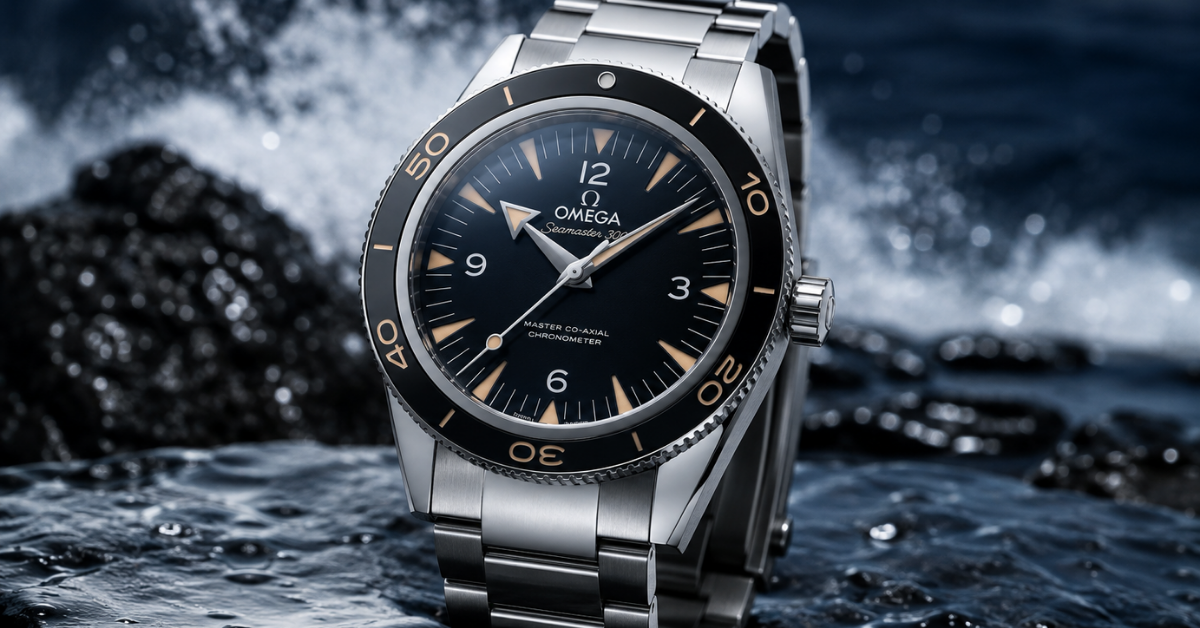
The Omega Seamaster 300 is a modern reissue of Omega's first professional dive watch from 1957, reintroduced in 2014 with a 41mm steel case, 300m water resistance, and Omega's Co-Axial Master Chronometer movement. Unlike the Bond-associated Seamaster Diver 300M, the Seamaster 300 leans into vintage military authenticity — broad arrow hands, applied rectangular markers, and a design that stayed close to the original watch that equipped Cold War-era Royal Navy divers. Current pricing generally runs $5,800 to $7,500 depending on configuration.
Omega has two current watches that both trace back to genuine diving heritage, and it's easy to conflate them if you only know the more famous one. The Seamaster Diver 300M is the Bond watch — wave dial, ceramic ballistics, a design language built for the 1990s and refined ever since. The Seamaster 300 is something different: a direct reissue of the original 1957 watch, built for a buyer who wants the actual historical design rather than a modern reinterpretation of it.
This review covers what that reissue actually gets right, where it sits against its more famous sibling, and who it's genuinely built for.
Where It Actually Comes From
Omega released the original Seamaster 300 in 1957 as the brand's first purpose-built professional dive watch. It wasn't a marketing exercise — the watch saw real service equipping military divers, including British Royal Navy divers during the Cold War era, valued for the kind of straightforward legibility and water resistance that mattered when the watch was doing an actual job underwater rather than accessorizing a dinner jacket.
Omega brought the design back in 2014, not as a loose "vintage-inspired" reinterpretation but as a genuinely faithful reissue — broad arrow hands, applied rectangular luminous hour markers, and a dial layout that reads as authentically 1950s rather than retro pastiche. It's a deliberate contrast to how most brands handle heritage reissues, which tend to modernize the design considerably while keeping only a few nostalgic details.
The Case and Design
The current Seamaster 300 comes in a 41mm stainless steel case, roughly 14mm to 14.7mm thick — noticeably substantial on the wrist, part of what gives it real vintage-tool-watch presence rather than a slimmed-down modern feel. It's water resistant to 300 meters, carries a sapphire crystal, and shows off its movement through an exhibition caseback, a detail the original 1957 watch obviously never had but one that suits a modern buyer who wants to see what they're paying for.
Two dial colorways make up the core lineup — black and blue — each paired with a matching unidirectional bezel. Both share the same broad arrow hand design and rectangular luminous markers that anchor the watch's vintage identity, available on either a three-link steel bracelet or a leather strap depending on the specific reference.
The Movement: Where It Actually Gets Modern
This is where the Seamaster 300 stops pretending to be 1957 and commits fully to current Omega engineering. It runs the Co-Axial Master Chronometer Calibre 8912 — a 29mm movement delivering 60 hours of power reserve and beating at 25,200 vibrations per hour, independently METAS-certified for both accuracy and magnetic resistance. It's the same movement family underlying much of Omega's current lineup, and it means the watch performs like a thoroughly modern chronometer despite its historically faithful exterior.
For a deeper look at how this Master Chronometer certification actually works — the independent testing standard behind it — our Seamaster Diver 300M review covers the same certification standard in Omega's more mainstream diver, useful context if you're comparing the two directly.
Seamaster 300 vs. Seamaster Diver 300M: The Real Difference
These two watches get confused constantly, and the confusion is understandable given the shared "Seamaster" and "300" naming. But they're built for genuinely different buyers.
The Diver 300M is the design Omega has continuously evolved since 1993, carrying the wave-pattern dial, ceramic bezel, helium escape valve, and four decades of James Bond association — a watch built to feel contemporary and instantly recognizable. The Seamaster 300 deliberately does the opposite: it's not trying to feel current at all. No wave dial, no helium valve, no cinematic baggage — just the original 1957 design language rebuilt with a modern movement underneath. If instant brand recognition and the Bond connection matter to you, the Diver 300M is the better fit. If you want the genuine historical article with modern reliability, the Seamaster 300 is built specifically for that buyer instead.
Pricing and Where It Sits
Current Seamaster 300 pricing generally runs $5,800 to $7,500 depending on bracelet choice and specific configuration, positioning it in a similar range to the Diver 300M rather than as a budget or premium alternative — this is a lateral choice within Omega's catalog, not an upgrade or downgrade. If you're weighing it against Omega's broader lineup, our Omega Watches Buying Guide covers how the full catalog's pricing tiers compare.
Who Should Actually Buy One
The Seamaster 300 makes the most sense for buyers who specifically value historical authenticity over contemporary design cues — someone drawn to military watch history, or who simply prefers a cleaner, less ornamented dial than the Diver 300M's wave pattern offers. It's a statement piece for buyers who know what they're looking at, rather than a watch built to be instantly recognized by people who don't follow watches closely. If versatility across dressier and sportier settings matters more to you than diving heritage specifically, our Aqua Terra review covers a different Seamaster family member built around exactly that kind of all-purpose daily wear instead.
Buying With Confidence
Whether new or pre-owned, buying from an authorized source removes any authentication risk. Given how much money is involved and how recognizable the Seamaster name is, our guide on how to spot a fake Omega watch covers the checks worth running before any pre-owned purchase.
FAQ
What's the difference between the Seamaster 300 and Seamaster Diver 300M? The Seamaster 300 is a faithful reissue of Omega's original 1957 dive watch with vintage styling and no Bond association, while the Diver 300M is the modern, continuously evolved design most associated with James Bond, featuring a wave-pattern dial and helium escape valve the Seamaster 300 lacks.
Is the Omega Seamaster 300 based on a real historical watch? Yes — it's a reissue of Omega's first professional dive watch from 1957, which saw genuine service equipping military divers, including British Royal Navy divers, during the Cold War era.
What movement does the current Seamaster 300 use? The Co-Axial Master Chronometer Calibre 8912, delivering 60 hours of power reserve and independently METAS-certified for accuracy and magnetic resistance.
How much does the Omega Seamaster 300 cost? Generally $5,800 to $7,500 depending on bracelet choice and configuration, positioning it similarly to the Diver 300M rather than as a budget alternative.
Is the Seamaster 300 water resistant enough for actual diving? Yes — it carries a genuine 300-meter water resistance rating, well beyond what recreational diving requires.
Conclusion
The Seamaster 300 succeeds by refusing to modernize the parts of its design that didn't need fixing. It keeps the 1957 original's broad arrow hands, rectangular markers, and straightforward dial layout intact, while quietly upgrading everything under the hood to current Master Chronometer standards. It's not trying to be the more famous Diver 300M, and buyers looking for that watch's cinematic recognition should look there instead — but for anyone who wants the genuine historical design Omega actually built for military divers, this is that watch, done properly.
Editor-in-Chief
Editorial Team