On this page
Most watch complications exist to impress. A power reserve indicator is one of the rare ones that actually exists to be useful, and that distinction is worth understanding before deciding whether Omega's De Ville version earns its extra cost over the standard line already covered in our full De Ville review.
What a Power Reserve Indicator Actually Does
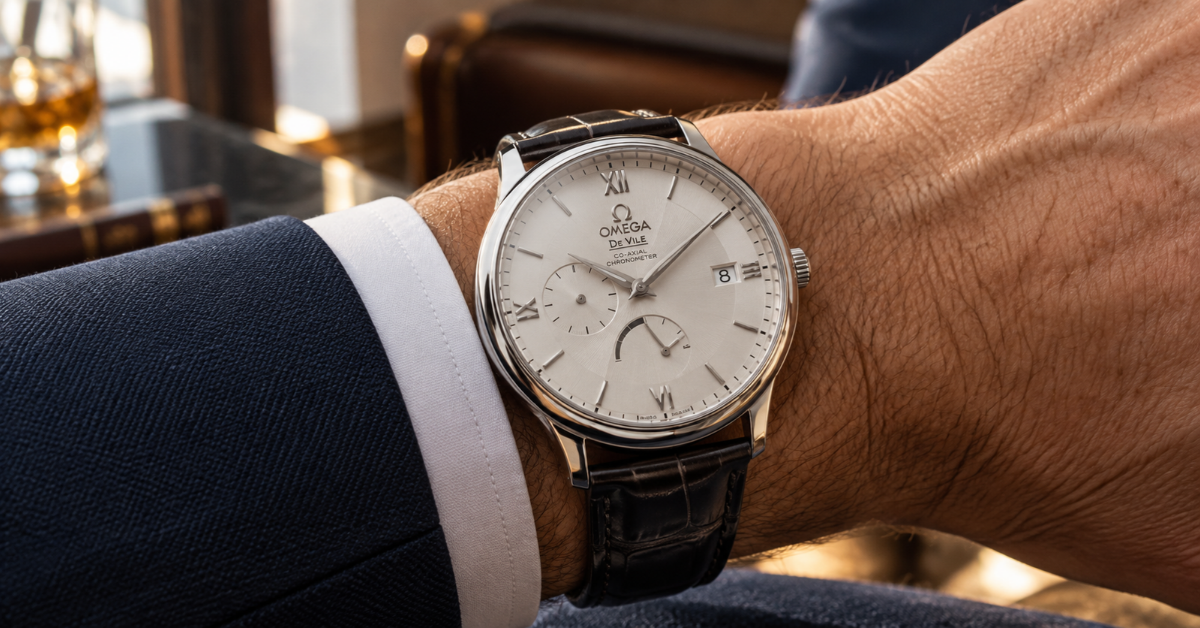
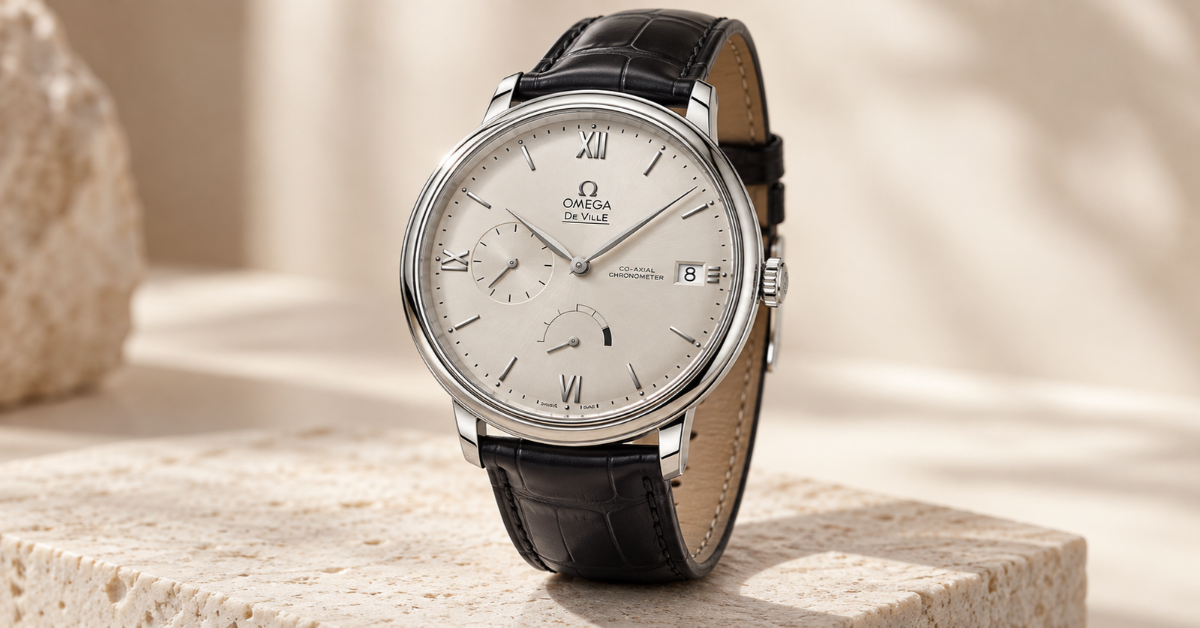
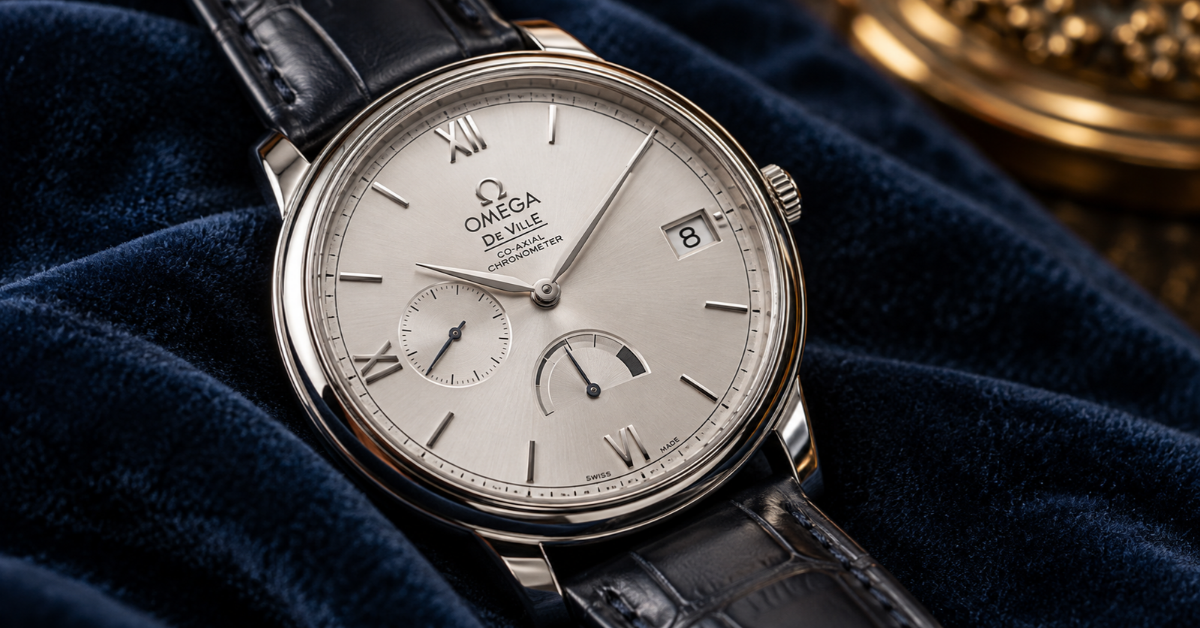
Think of it as a fuel gauge for a mechanical watch. An automatic movement stores energy in its mainspring as you wear it, and that stored energy gradually depletes if the watch sits unworn — eventually stopping entirely once it runs out. Without a power reserve indicator, you simply don't know how close to empty a watch actually is until it stops on you, mid-week, with the date needing a reset. The indicator removes that guesswork, typically displayed as a small arc or subdial — on the De Ville, positioned at 6 o'clock — showing roughly how many hours of running time remain before the watch needs winding again.
That's a genuinely functional complication, not a decorative one. It solves a real, everyday annoyance rather than simply adding visual complexity for its own sake.
The Movement: Caliber 2627
The De Ville Power Reserve, including the Prestige-line version, ran on Omega's Caliber 2627 — a Co-Axial escapement movement built on the Omega 2500 base, itself derived from the well-regarded ETA 2892-A2 architecture. It carries 29 jewels and delivers a 48-hour power reserve, COSC-certified as a chronometer to a precision standard of -4/+6 seconds a day.
Worth being precise here, since it's an honest distinction rather than a knock against the watch: that COSC-only certification is a different, less stringent standard than the Master Chronometer certification found across Omega's current lineup, which adds independent METAS testing for magnetic resistance and tighter overall precision. Our Co-Axial escapement explainer covers how the underlying friction-reducing technology in Caliber 2627 actually works — the same core engineering Omega still uses, just certified to an earlier-generation standard than what you'd find in a current Seamaster or De Ville Prestige automatic today.
Case and Dial
Depending on the specific reference, the De Ville Power Reserve case runs either 38.7mm or 39.5mm, generally 10.95mm to 11.2mm thick, with a lug-to-lug spanning roughly 45.5mm to 48.3mm. Water resistance sits at a formal-watch-appropriate 30 to 100 meters depending on the exact reference — consistent with the De Ville line's identity as a dress watch rather than a daily-wear sport piece, as covered in our main review of the collection.
The dial itself genuinely earns the "extra complication" framing in the title: beyond hours and minutes, you're getting a date window, a small seconds subdial, and the power reserve gauge all sharing space on the same face — a considerably busier, more technically engaged dial layout than the standard De Ville Prestige's cleaner three-hand design.
Pricing Across Materials
Steel references historically retailed around $4,950 to $5,500. Solid 18-karat gold versions sat in a dramatically different tier, with documented pricing from $24,390 up to roughly $27,100 depending on configuration and whether the dial carried diamond-set detailing. That's a genuinely wide spread even within one model name, and it's worth comparing directly against the entry-level De Ville Prestige pricing covered in our full review before deciding whether the power reserve function justifies the premium over Omega's simpler current dress watch options.
A Note on Current Availability
This is worth being direct about rather than implying the watch is sitting on every authorized dealer's shelf today: the De Ville Power Reserve, in the specific Caliber 2627 configuration covered here, now shows up predominantly through pre-owned specialists and secondary-market listings rather than as a heavily stocked current release. If you're specifically drawn to this complication, checking directly with an authorized Omega retailer for current availability, or shopping the pre-owned market with the authentication fundamentals covered in our general guide to spotting a fake Omega watch, is the realistic path forward.
So, Is the Extra Complication Worth It?
For the right buyer, genuinely yes. A power reserve indicator isn't a complication you admire once and then ignore — it's one you actually use, every time you pick the watch up after a few days off the wrist, to know at a glance whether it needs winding before you put it on. That's real, ongoing utility most complications don't offer.
Whether it's worth it over Omega's current De Ville Prestige lineup depends on what you're actually optimizing for. If you want the latest Master Chronometer certification and METAS-verified magnetic resistance, our full De Ville review covers the current Prestige, Trésor, and Tourbillon options built to that standard. If you specifically want the power reserve function and are comfortable with an earlier-generation COSC certification and a pre-owned purchase, the Caliber 2627 version remains a genuinely well-engineered, practically useful watch worth seeking out — just go in with accurate expectations about where you'll actually find one.
Buying With Confidence
Given this model's current secondary-market positioning, authentication and provenance matter more than they would with a current-production watch purchased new. Our Omega Watches Buying Guide covers how to navigate pre-owned Omega purchases with confidence more broadly.
FAQ
What does a power reserve indicator actually tell you? How much stored energy remains in the watch's mainspring before it needs winding — functioning like a fuel gauge for a mechanical movement, rather than letting the watch stop unexpectedly.
What movement powers the Omega De Ville Power Reserve? Caliber 2627, a Co-Axial escapement movement with 29 jewels and a 48-hour power reserve, COSC-certified to -4/+6 seconds a day.
Is the De Ville Power Reserve's certification the same as current Omega Master Chronometer watches? No — it carries COSC chronometer certification only, an earlier and less stringent standard than the independently METAS-tested Master Chronometer certification found on Omega's current lineup.
How much does an Omega De Ville Power Reserve cost? Steel references historically ran $4,950 to $5,500, while solid 18-karat gold versions ranged from roughly $24,390 to $27,100 depending on configuration.
Can I still buy a new Omega De Ville Power Reserve today? It's largely found through pre-owned specialists and the secondary market rather than widely stocked as a current release, so checking directly with an authorized retailer for availability is worthwhile before assuming it's readily available new.
Conclusion
A power reserve indicator earns its place on a dial in a way plenty of complications don't — it's genuinely useful every single time you pick the watch up, not just a detail to admire once. The Caliber 2627 version delivers that function through solid, well-regarded Co-Axial engineering, even if its COSC-only certification and now-limited current availability mean it's a different proposition than Omega's latest Master Chronometer dress watches. For the buyer who actually wants this specific function, it's worth seeking out. For everyone else, Omega's current De Ville lineup likely serves you better.
Editor-in-Chief
Editorial Team