On this page
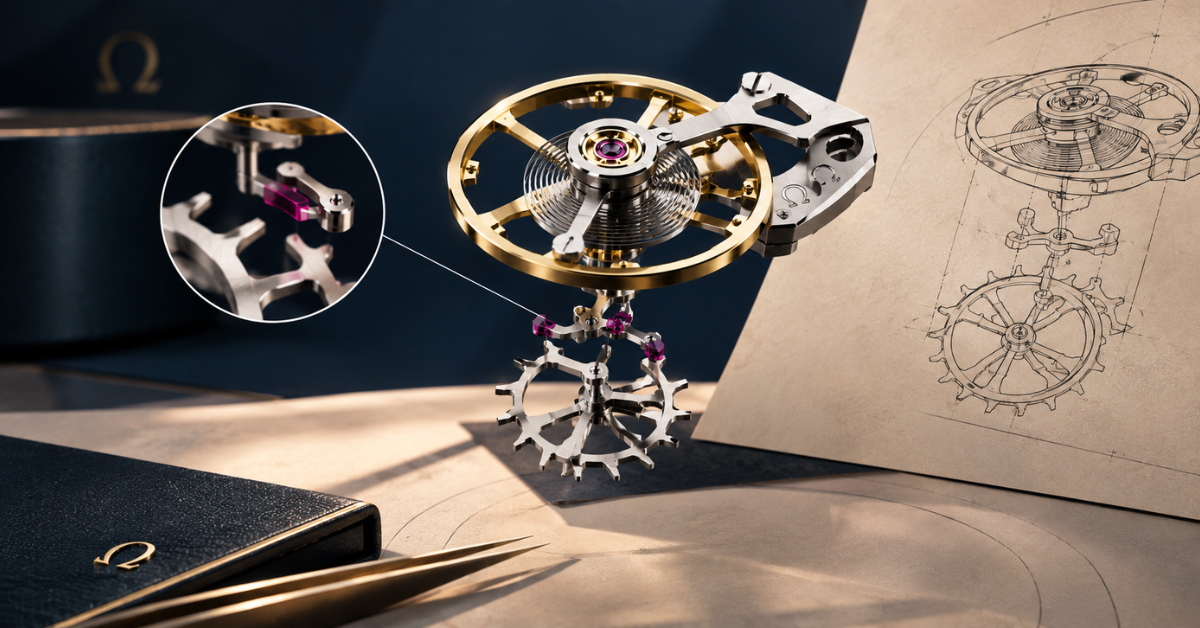
An escapement is the part of a mechanical watch that releases energy from the wound mainspring in small, regular bursts — it's what actually makes a mechanical watch tick and keep steady time. Omega's Co-Axial escapement, developed with the legendary watchmaker George Daniels, changes how two key parts interact so they push against each other rather than sliding across one another, reducing friction significantly compared to the traditional Swiss lever escapement used in most mechanical watches. Less friction means the internal lubricant degrades more slowly, which is the actual engineering reason Omega can recommend a longer 5-to-8-year service interval instead of the 3-to-5 years typical elsewhere in the industry.
"Escapement" is one of those watchmaking words that gets used constantly without much explanation, which makes it easy to nod along without actually understanding what Omega is claiming when it talks about the Co-Axial. Here's the plain version, without assuming you already know how a mechanical watch works.
What an Escapement Actually Does
Every mechanical watch stores energy in a wound spring, called the mainspring. If that energy released all at once, the watch would simply unwind instantly and be useless for telling time. The escapement's job is to release that stored energy in small, precisely controlled bursts — each release corresponding to a tiny movement of the watch's gears, which is what actually turns the hands. That controlled release is also what produces the audible or felt "ticking" in a mechanical watch, and it's the component that determines how accurately the watch keeps time overall.
Think of it like a dam controlling a river's flow — the mainspring is the full reservoir of energy, and the escapement is the mechanism making sure only a small, steady amount gets through at a time rather than everything rushing out at once.
The Problem With the Traditional Design
Most mechanical watches, across nearly every brand, use what's called a Swiss lever escapement—a design that's been the industry standard for centuries and works well. Its limitation is mechanical: key parts inside it slide across each other as they interact, and that sliding motion creates friction. Friction requires lubrication to manage, and that lubrication gradually breaks down and thickens over time, increasing friction further as the oil degrades. That's the actual reason mechanical watches need periodic servicing — not because they're poorly built, but because this specific kind of friction is a built-in feature of how the traditional escapement works.
What Omega's Co-Axial Design Actually Changes
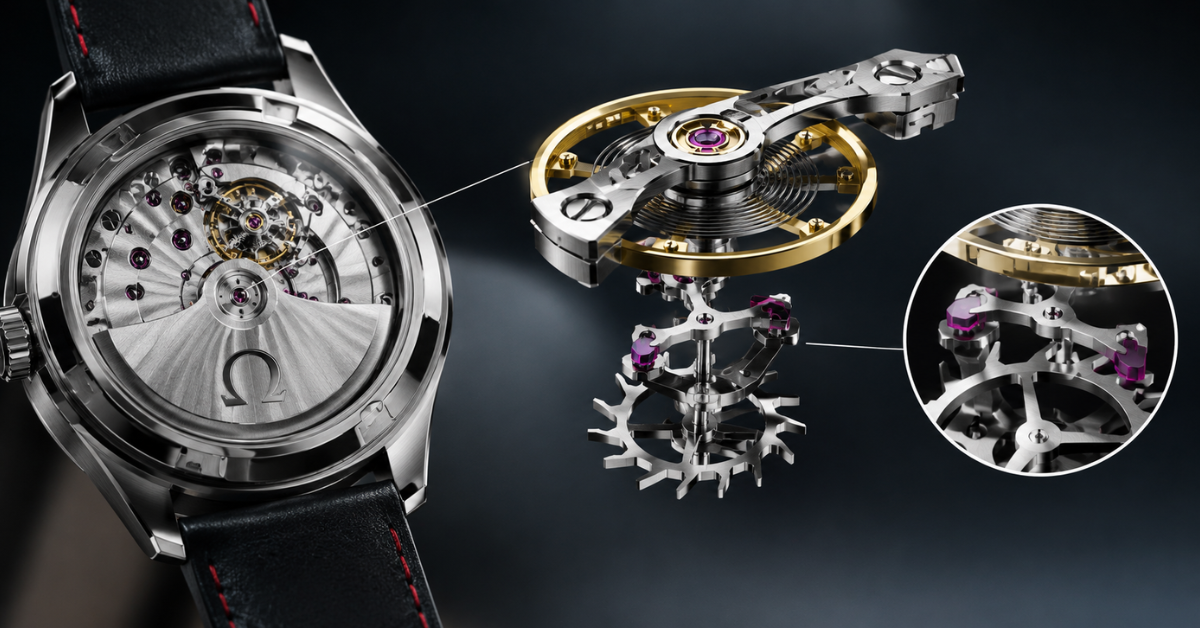
Omega's Co-Axial escapement, developed in partnership with George Daniels — widely regarded as one of the most significant independent watchmakers of the 20th century — reworks how the equivalent parts interact. Rather than sliding across each other the way a traditional lever escapement does, the Co-Axial's key components push against each other in a more radial motion, closer to a gentle nudge than a drag. That difference in motion type is what reduces friction so significantly compared to the traditional design.
Less friction has a direct, practical consequence: the lubricant inside a Co-Axial movement takes considerably longer to degrade to the point where it affects accuracy or wear. That's not a marketing claim — it's the actual mechanical reason behind Omega's own official service recommendation of every 5 to 8 years, longer than the 3-to-5-year interval common at many comparable Swiss brands still using traditional escapement designs. Our piece on how long an Omega watch actually lasts covers that servicing guidance in more detail, including what actually happens during a full service.
Where You'll Find It Today
The Co-Axial escapement is now standard across Omega's current Master Chronometer movement lineup, present in watches spanning the Seamaster, Speedmaster, and Constellation families. It's worth being precise about one thing, though: the Co-Axial escapement and Master Chronometer certification are related but distinct. The escapement is a specific mechanical design inside the movement; Master Chronometer certification is a separate, independent testing process conducted by METAS, Switzerland's federal metrology institute, that verifies a fully cased watch's accuracy and magnetic resistance. Our guide on verifying Omega's Master Chronometer certification covers exactly what that separate certification process actually tests, and how to confirm a specific watch has genuinely passed it.
Omega's testing capability has continued advancing well beyond the original Co-Axial breakthrough, too — our coverage of the Constellation Observatory launch covers a genuinely new acoustic testing method developed at Omega's own Laboratoire de Précision, a direct continuation of the same engineering ambition that produced the Co-Axial escapement in the first place.
Why This Actually Matters to Owners
Beyond the technical explanation, the practical takeaway is straightforward: a watch with a Co-Axial escapement genuinely needs less frequent maintenance than a comparable watch using a traditional lever escapement, and that's backed by real mechanical reasoning, not just a longer warranty number picked for marketing purposes. If you're weighing long-term ownership costs across Omega's current lineup, our Omega Watches Buying Guide covers how movement technology factors into that decision across different collections.
FAQ
What does an escapement actually do in a mechanical watch? It releases the energy stored in the wound mainspring in small, controlled bursts, which is what makes the watch tick and determines how accurately it keeps time.
Who invented Omega's Co-Axial escapement? It was developed in partnership with George Daniels, widely regarded as one of the most significant independent watchmakers of the 20th century.
How is the Co-Axial escapement different from a traditional Swiss lever escapement? Its key components push against each other in a radial motion rather than sliding across one another, significantly reducing the friction that causes traditional escapements to need more frequent lubrication and servicing.
Does the Co-Axial escapement mean an Omega never needs servicing? No — it still needs periodic servicing, but the reduced friction lets Omega recommend a longer 5-to-8-year interval rather than the 3-to-5 years typical for watches using traditional escapement designs.
Is the Co-Axial escapement the same thing as Master Chronometer certification? No—the Co-Axial escapement is a specific mechanical design inside the movement, while Master Chronometer certification is a separate, independent testing process verifying the fully cased watch's accuracy and magnetic resistance.
Conclusion
The Co-Axial escapement isn't a marketing term for "high quality" in the abstract—it's a specific, genuine mechanical solution to a specific problem, reducing the friction that ages every traditional mechanical watch's lubrication over time. That's the real engineering behind Omega's longer service recommendation, and understanding it makes the rest of Omega's movement technology, including its Master Chronometer certification, considerably easier to make sense of.
Editor-in-Chief
Editorial Team