On this page
- 1. De Ville Prestige
- 2. Constellation (Standard Line, Especially Quartz)
- 3. Two-Tone and Gold Configurations Across Both Dress Lines
- 4. Pre-Master Chronometer Generation Dress References
- 5. Entry-Level Quartz References Broadly
- Why This Doesn't Contradict What We Said About These Same Watches Being Undervalued
- What This Means If You're Buying
- FAQ
- Conclusion
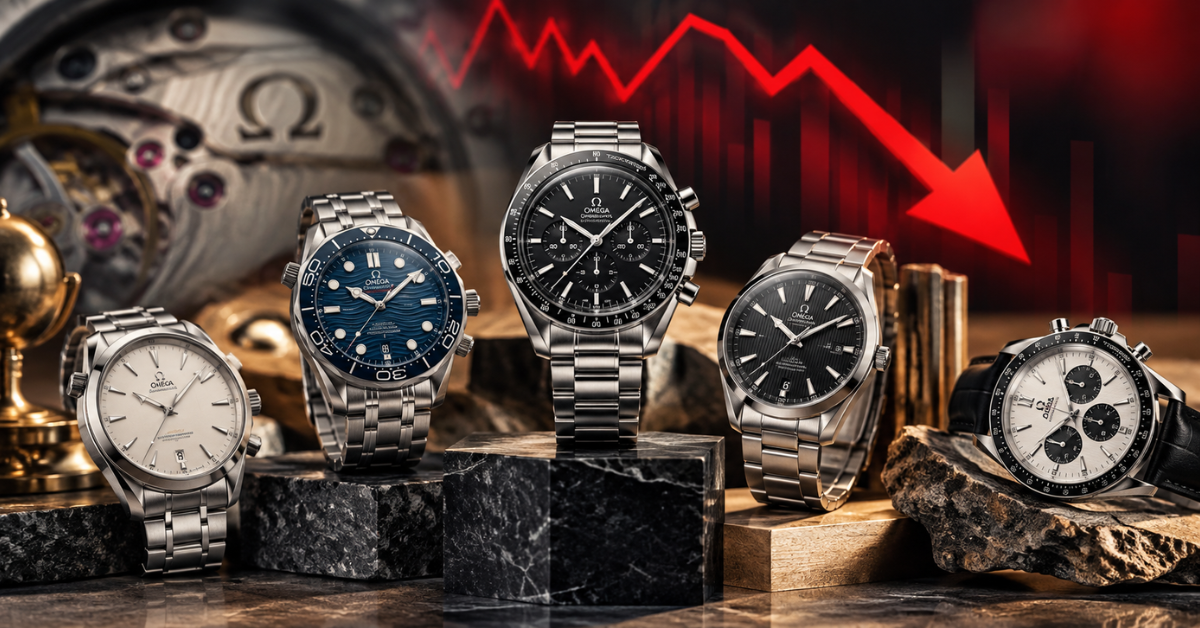
Omega's steel sports references — the Speedmaster Moonwatch, Seamaster Diver 300M, Planet Ocean — consistently hold 60% to 88% of retail value on the secondary market. The weakest performers sit at the opposite end of the same catalog: the De Ville Prestige, quartz Constellation references, and two-tone or gold configurations across both dress lines regularly retain only 40% to 65% of retail. The pattern is consistent across independent trackers — dress-oriented, quartz, and precious-metal Omega references depreciate meaningfully faster than the brand's sportier steel catalog, regardless of how strong the underlying engineering actually is.
This is a resale-performance question specifically, not a build-quality one — worth saying upfront, since our own coverage of Omega's genuinely undervalued models actually names some of the same watches discussed here. That's not a contradiction; it's two different measurements answering two different questions, and we address exactly how they fit together further down. First, the resale numbers themselves.
1. De Ville Prestige
This is the most consistently named weak performer across independent trackers, and the numbers are specific enough to be genuinely useful. Multiple resale trackers describe the De Ville Prestige as having the weakest resale value among major current Omega references, generally retaining just 43% to 65% of retail depending on configuration — meaning a loss of roughly 35% to 57% shortly after purchase. That pattern holds across both quartz and Powermatic 80 automatic versions of the Prestige line.
The upside for buyers: clean pre-owned De Ville Prestige examples regularly trade in the $2,500 to $3,500 range, making it arguably the most accessible entry point into genuine Master Chronometer-adjacent Omega engineering on the secondary market, even though that same engineering doesn't translate into resale strength.
2. Constellation (Standard Line, Especially Quartz)
The Constellation shows up alongside the De Ville in nearly every resale analysis as Omega's other consistently weak performer, with quartz references specifically flagged as trading toward the lower end of that range — commonly 40% to 55% of retail. This applies to the standard Manhattan line rather than the newly launched Observatory tier, which is too recent to have established resale data of its own.
3. Two-Tone and Gold Configurations Across Both Dress Lines
This is a pattern worth understanding on its own, since it cuts across model names rather than sitting within just one collection. Precious-metal and two-tone Omega configurations — gold or Rolesor-style combinations on both De Ville and Constellation references — consistently depreciate faster than their steel equivalents. It's a broader trend across luxury watchmaking generally, not unique to Omega: gold and two-tone models tend to attract a narrower buyer pool on the secondary market than steel sports references, which pulls resale pricing down further regardless of how the underlying movement performs.
4. Pre-Master Chronometer Generation Dress References
Older De Ville and Constellation references, produced before Omega's shift to Master Chronometer certification around 2015, tend to depreciate even further than their current-generation counterparts. Without the METAS-certified magnetic resistance and precision testing that current references carry, these older pieces compete for buyer attention against both the current lineup and a broader vintage market, a combination that pushes resale prices down further still. If you're evaluating whether a specific dress reference carries current certification, our piece on verifying Omega's Master Chronometer certification covers how to check a specific watch's actual status.
5. Entry-Level Quartz References Broadly
Beyond the specific De Ville and Constellation callouts above, the general pattern holds across Omega's more accessible quartz lineup: watches without a mechanical movement, a display caseback, or a complication to differentiate them tend to compete more directly against their own new-retail price, since a buyer choosing between new and pre-owned has less reason to accept a used watch's condition uncertainty for a comparatively small discount — until that discount becomes steep enough to matter, which is exactly what tends to happen with this tier over time.
Why This Doesn't Contradict What We Said About These Same Watches Being Undervalued
This is worth addressing directly rather than leaving it as an inconsistency for readers to notice on their own. Our undervalued Omega models coverage makes the case that the De Ville Prestige and standard Constellation offer genuine Master Chronometer engineering well ahead of their market recognition — and that's still true. What this piece measures is something different: how those same watches actually perform on resale, which is driven by buyer demand and market recognition, not by how well-engineered the watch underneath actually is.
Put plainly: a watch can be genuinely underrated in what it delivers and still be a weak resale performer, and those two facts reinforce each other rather than conflict. Weak resale demand is largely why these watches remain underrated in the first place — fewer buyers chasing them keeps both their reputation and their pre-owned pricing modest, which is precisely what makes them such strong value for a buyer who wants the engineering without paying for the reputation. If you're shopping pre-owned specifically, that combination — genuine capability, weak resale demand — is exactly what you want to find, not something to avoid.
What This Means If You're Buying
If resale value is your primary concern, this data points you toward Omega's steel sports references instead — the Speedmaster Moonwatch, Seamaster Diver 300M, and Planet Ocean all consistently outperform the models discussed here, sometimes by a wide margin. Our Omega vs Rolex value comparison covers how Omega's resale performance compares to Rolex's more scarcity-driven market more broadly, useful context for understanding why this depreciation pattern exists industry-wide, not just within Omega's own catalog.
If you're buying to wear rather than to eventually resell, none of this should discourage you from any of these five categories — you're simply buying at a price point the market has already discounted, often considerably, for engineering that performs identically to Omega's stronger resale categories.
FAQ
Which Omega model has the weakest resale value? The De Ville Prestige is the most consistently named weak performer across independent trackers, typically retaining just 43% to 65% of retail depending on configuration.
Do gold and two-tone Omega watches depreciate faster than steel versions? Yes — precious-metal and two-tone configurations across both the De Ville and Constellation lines consistently depreciate faster than their steel equivalents, reflecting a narrower buyer pool on the secondary market.
Does fast depreciation mean these Omega watches are poorly made? No — depreciation reflects market demand and recognition, not build quality; these references generally carry the same Master Chronometer engineering as Omega's stronger resale performers.
Why do quartz Omega watches depreciate faster than automatics? Quartz references without a mechanical movement or complication to differentiate them tend to compete more directly against their own new-retail price, which pushes secondary-market discounts deeper over time.
Is it a good idea to buy a fast-depreciating Omega pre-owned? Often yes — since most of the depreciation has already occurred by the time the watch reaches the secondary market, a pre-owned purchase lets you access genuine Omega engineering at a price the first owner has already discounted for you.
Conclusion
The De Ville, standard Constellation, precious-metal configurations, older dress-line generations, and entry-level quartz references make up Omega's weakest resale category — a real, consistent pattern across independent trackers, not a knock on the watches themselves. If anything, that gap between genuine engineering and market demand is exactly what makes these same watches worth a serious look on the pre-owned market, where someone else has already absorbed the loss you'd otherwise take new.
Editor-in-Chief
Editorial Team